What is the first step of doing SEO? It’s not writing articles, building backlinks, or tweaking code—it’s keyword research.
Pick the wrong keywords, and every effort afterward heads in the wrong direction. You spend three months ranking “CRM system” on the first page, only to discover that most people searching for it are looking for free downloads—not your target customers at all.
For B2B companies, the core of keyword research is not “finding high-search-volume terms,” but “finding the terms your customers will search.” A highly targeted long-tail keyword with 50 monthly searches is far more valuable than a broad term with 5,000 monthly searches and minimal conversion potential.
This article systematically walks through the complete methodology for keyword research on B2B enterprise websites (for the full SEO methodology, see the “Enterprise SEO Complete Guide”). From strategy to tools, from templates to case studies, you’ll learn how to build your own keyword system step by step.
The Foundational Logic of B2B Keyword Research
Start from the User Decision Journey
A B2B customer’s purchase decision is not made in an instant—it’s a gradual process. From “not knowing this thing exists” to “finally signing the contract and paying,” it typically goes through five stages:
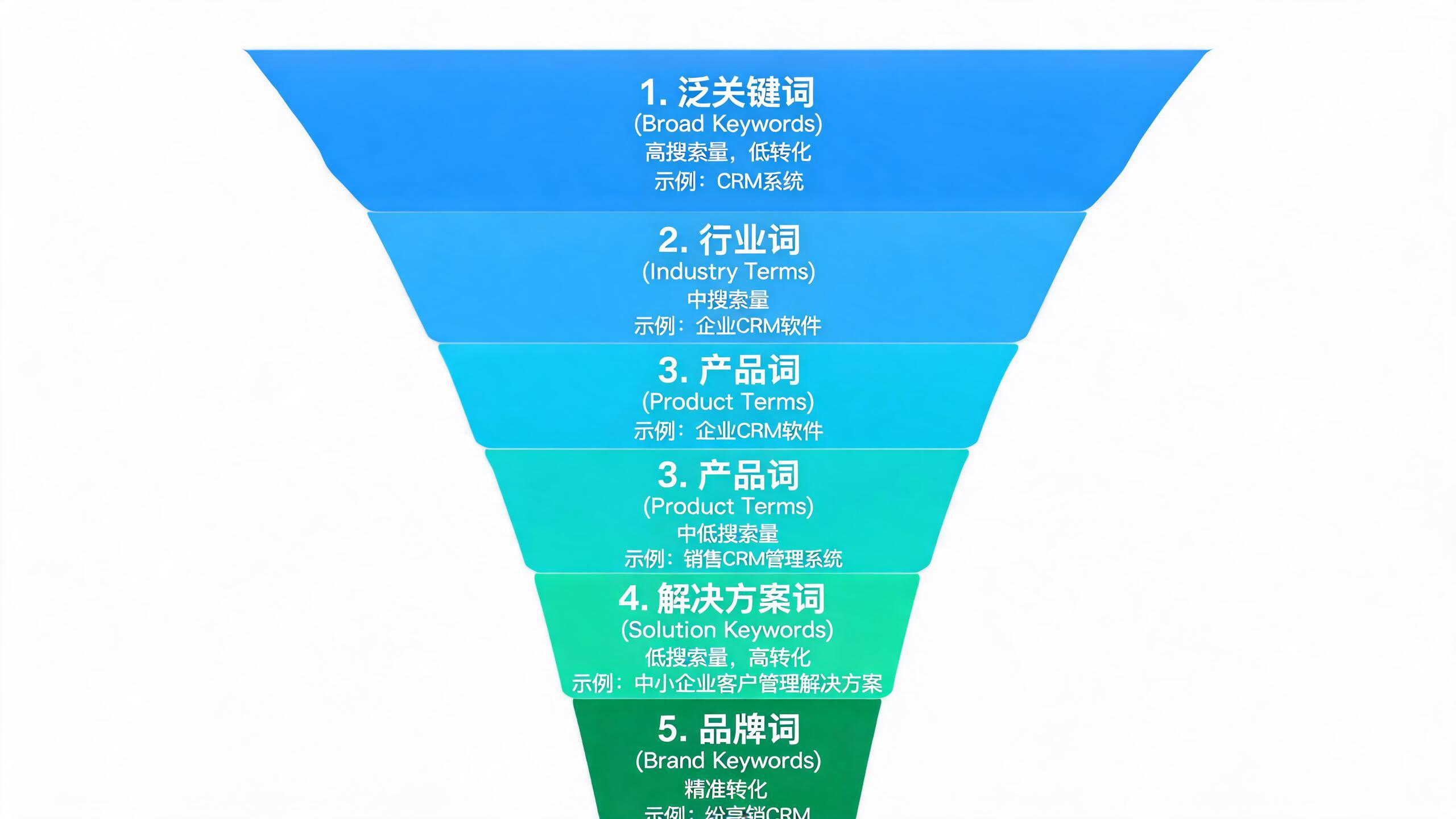
Figure: B2B user decision journey and the corresponding keyword type funnel
Users at different stages search for completely different keywords. A solid keyword strategy should cover the entire user decision journey, not just fixate on the “buying keywords” at the final step.
Why B2B Can’t Just Target Head Terms
Many companies jump in and say: “I want to rank for ‘CRM system’ on the first page.”
Let’s look at a set of data:
| Keyword | Monthly Search Volume | Commercial Intent | Conversion Difficulty | Competition |
|---|---|---|---|---|
| CRM system | 5,400 | Low | Extremely High | 🔴 Extremely Hard |
| CRM system enterprise edition | 1,000 | Medium-High | High | 🟠 Hard |
| How much does a CRM system cost | 800 | High | Medium | 🟡 Medium |
| How to choose CRM for SMB | 400 | Medium-High | Medium | 🟡 Medium |
| Salesforce vs Fxiaoke | 200 | Extremely High | Low | 🟢 Easy |
| CRM system implementation service provider | 100 | Extremely High | Very Low | 🟢 Easy |
The problem is:
- People searching for “CRM system” might be students writing papers, looking for free versions, or competitors doing research—fewer than 5% are actually looking to buy.
- People searching for “CRM system implementation service provider” already know they need someone to help implement it—nearly 100% are potential customers.
The golden rule of B2B SEO: The lower the search volume of a keyword, the higher its commercial value tends to be.
Because the more specific and in-depth a user’s search query is, the further along they’ve already moved through the awareness and consideration stages—and the closer they are to making a decision.
Five Keyword Types and Search Intent
Keywords for B2B enterprise websites can be divided into five categories, corresponding to different stages of the user decision journey:
Type 1: Core Keywords (Seed Keywords)
Definition: The 3-5 most central terms for your business—usually your product or service names.
Examples (using CRM AI upgrade consulting as an example):
- CRM AI upgrade
- FDE service
- AI implementation consulting
- Enterprise AI transformation
Characteristics:
- Medium to high search volume
- Highly competitive
- Average commercial intent
- Suitable for “pillar page” content
Use cases:
- Homepage title and meta description
- Main product/service pages
- Pillar articles in content clusters
Type 2: Scenario Keywords (Pain Point Keywords)
Definition: Problems or needs users encounter in specific business scenarios.
Examples:
- How to improve low lead conversion rates
- Customer churn prediction system
- Inaccurate sales forecasting
- How to solve slow customer service response
Characteristics:
- Medium search volume
- Medium-high commercial intent
- Medium competition
- Easiest to differentiate content
Use cases:
- Blog article main titles
- Problem-solution style content
- Easiest to capture long-tail traffic
Type 3: Comparison Keywords (Selection Keywords)
Definition: Terms users search when comparing different products or solutions.
Examples:
- Salesforce vs Fxiaoke
- FDE vs outsourcing: what’s the difference
- Zoho vs HubSpot: which is better
- Build CRM in-house or buy SaaS
Characteristics:
- Low search volume (usually 50-500/month)
- Extremely high commercial intent (the user is already evaluating options!)
- Low competition
- Highest conversion rate
Use cases:
- Comparison articles
- Selection guides
- Product reviews
Importance: Comparison keywords are the crown jewel of B2B SEO. Users searching for these terms have already reached the decision stage and are the highest-quality potential customers.
Type 4: Question Keywords (Q&A Keywords)
Definition: Keywords users search in question form, usually starting or ending with “how,” “what,” “why,” or “is/are.”
Examples:
- How much does AI lead scoring cost?
- Do SMBs need FDE?
- How to choose a CRM system?
- Why do AI projects always fail?
Characteristics:
- Extremely high volume (long-tail)
- Low individual search volume, but large aggregate volume
- Mixed commercial intent
- Suitable for FAQ and Q&A content
Use cases:
- FAQ pages
- FAQ sections in blog articles
- Q&A platform content
- Easy to capture Google “People Also Ask” features
Type 5: Industry Keywords (Vertical Keywords)
Definition: Keywords with industry qualifiers, precisely targeting a specific industry.
Examples:
- Manufacturing CRM system
- Medical device industry CRM
- Foreign trade enterprise customer management
- Financial industry AI implementation
Characteristics:
- Low search volume (usually 10-100/month)
- Extremely high precision
- Very low competition
- High conversion rate
Use cases:
- Industry solution pages
- Vertical industry case study articles
- Localized/industry-specific SEO
The Five-Step Keyword Research Workflow
Step 1: List Seed Keywords (Brainstorm)
Starting from your business, first list 10-20 core seed keywords.
Methods:
- What is your product/service called?
- How do your customers typically describe your service?
- What pain points do customers have? (Use the customer’s language, not your jargon)
- What keywords are competitors targeting?
- What type of customers do you most want to acquire?
Output: A list of 10-20 seed keywords.
Example (FDE service):
1 | Seed keyword list: |
Step 2: Expand the Keyword List (Expand)
Based on seed keywords, use various tools and methods to expand into as many related keywords as possible.
Expansion methods:
| Method | Description | Tools |
|---|---|---|
| Google Related Searches | “Related searches” at the bottom of search results | Google Search |
| Google Autocomplete | Dropdown suggestions in the search box | Google Search |
| People Also Ask (PAA) | Q&A boxes in search results | Google Search |
| Keyword Planner | Google’s official keyword data | Google Keyword Planner |
| Competitor Analysis | Analyze keywords competitors rank for | Ahrefs / SEMrush |
| Q&A Websites | Popular questions on Zhihu, Quora | Zhihu / Quora |
| Forums & Communities | Discussion topics in industry forums | V2EX / industry groups |
| Content Platforms | Popular titles on blogs, newsletters | WeChat Search |
Goal: Expand from 10 seed keywords to 100-200 candidate keywords.
Tips:
- Search for “your seed keyword + vs” to find plenty of comparison keywords
- Search for “your seed keyword + how” to find plenty of question keywords
- Search for “your seed keyword + price/cost/how much” to find high commercial intent keywords
Step 3: Filter and Categorize (Filter & Categorize)
Filter and categorize the 100-200 expanded keywords.
Filtering criteria:
| Dimension | Exclude | Keep |
|---|---|---|
| Relevance | Terms unrelated to your business | Terms your target customers will search |
| Search Volume | Monthly searches < 5 (too niche) | Monthly searches 10-5000 (reasonable range) |
| Commercial Value | Those looking for free stuff, tutorials, or cracks | Those with purchase or consulting intent |
| Competition | Monopolized by giants, no chance at all | Where there is room to enter |
Categorization methods:
- By five types: Core / Scenario / Comparison / Question / Industry
- By priority: P0 (do now) / P1 (within 3 months) / P2 (long-term)
- By content format: Guide / Comparison / Case study / Q&A
Step 4: Assess Competitive Difficulty (Competition Analysis)
To evaluate whether a keyword can be ranked, look at three dimensions:
1) Domain Authority (DR/DA)
- Look at the average DR/DA of the first-page results
- If the first page is full of DR 70+ big sites, a new site will struggle to compete
- Benchmark: You have a chance only if the gap is within your DR + 15
2) Content Quality
- How deep is the content of the first-page results?
- Is it thin content or in-depth long-form articles?
- Is there room to update outdated content?
3) Number of Backlinks
- How many backlinks do the first-page result pages have?
- Are they natural backlinks or manually built?
Quick assessment method:
Search the target keyword on Google and look at the top 10:
- ✅ If 3+ are small/medium websites → there is a chance
- ⚠️ If all are big sites but with mediocre content → you may break through with quality
- ❌ If all are Wikipedia, Baidu Baike, industry giants → don’t touch it for now
Step 5: Map Keywords to Content (Keyword Mapping)
Map each keyword to a specific page or piece of content to form a keyword map.
Keyword-to-content mapping table:
| Keyword | Type | Priority | Corresponding Page/Article | Status |
|---|---|---|---|---|
| FDE Forward Deployed Engineer | Core | P0 | Pillar page: Complete Guide to FDE | ✅ Published |
| FDE vs Outsourcing | Comparison | P0 | Comparison article | ✅ Published |
| Why AI Projects Need FDE | Pain Point | P0 | Question-style article | ✅ Published |
| FDE Project Delivery Process | Scenario | P1 | Process-style article | ✅ Published |
| FDE Pricing | Decision | P1 | Pricing article | ⏳ Planned |
| FDE Hiring vs Outsourcing | Comparison | P1 | Comparison article | ⏳ Planned |
Keyword Template: A Universal Template for B2B Enterprise Services
If you don’t know where to start, just apply this universal B2B enterprise services keyword template:
Core Keyword Layer (3-5 terms)
- [Service name]
- [Service name] company/service provider
- [Service name] consulting
- Enterprise [service name]
- [Industry] + [service name]
Scenario/Pain Point Keyword Layer (10-20 terms)
- How to solve [pain point]
- How to improve [metric]
- [System/process] optimization solution
- [Industry] [pain point] solution
- Why [problem]
- Causes of [problem]
- What to do about [problem]
Comparison Keyword Layer (5-10 terms)
- [Product A] vs [Product B]
- Difference between [Solution A] and [Solution B]
- Is [product] good? How is it?
- In-house vs outsourcing vs [solution]
- Is [solution] worth it? Is it reliable?
Decision/Price Keyword Layer (5-10 terms)
- How much does [service] cost
- [Service] pricing
- [Service] quote
- How is [service] charged
- [Service] price list
- [Service] fees
Question/FAQ Keyword Layer (20-50 terms)
- What is [service]?
- What is [service] used for?
- Why do you need [service]?
- How to implement [service]?
- How long until [service] shows results?
- What conditions does [service] require?
- Is [service] suitable for SMBs?
- How to choose a [service] company?
Industry Keyword Layer (10-20 terms)
- [Industry 1] + [service name]
- [Industry 2] + [service name]
- [Industry 3] + [service name]
- [Industry] [pain point] solution
- [Industry] enterprise [service name]
Quick Keyword Competitiveness Assessment Method
How do you assess competitiveness without paid tools? Use this free quick assessment method.
Google Top 10 Results Assessment Method
Search the target keyword and analyze the 10 results on the first page:
| Metric | Assessment Criterion | Score |
|---|---|---|
| Number of big sites | How many DR 70+ big sites are on the first page? | 0 = 5 pts, 1-2 = 3 pts, 3+ = 1 pt |
| Exact match | How many results have titles that exactly match the keyword? | 0-1 = 5 pts, 2-4 = 3 pts, 5+ = 1 pt |
| Content depth | Is the first-page content all thin? | Very thin = 5 pts, Average = 3 pts, Very deep = 1 pt |
| Page type | Are first-page results content pages or homepages/category pages? | More content pages = 5 pts, Mixed = 3 pts, More homepages = 1 pt |
| Update time | Is the content up to date? | All old = 5 pts, Mixed = 3 pts, All new = 1 pt |
Score interpretation:
- 20-25 points: 🟢 Very easy, expected to reach the first page in 1-3 months
- 15-19 points: 🟡 Medium difficulty, expected to reach the first page in 3-6 months
- 10-14 points: 🟠 Relatively hard, requires 6-12 months of continuous optimization
- 5-9 points: 🔴 Extremely hard, not recommended for new sites to focus on
Real Case: Assessing “FDE vs Outsourcing”
Search for “FDE vs traditional outsourcing”:
| Metric | Actual Situation | Score |
|---|---|---|
| Number of big sites | Almost no big sites—all small/medium blogs and enterprise sites | 5 |
| Exact match | 2-3 titles directly match | 3 |
| Content depth | Mostly simple introductions, lacking depth | 5 |
| Page type | Mainly blog articles | 4 |
| Update time | Content is relatively old, lacks AI-era perspectives | 5 |
Total: 22 points → 🟢 Very easy
This is why FDE is a blue-ocean keyword—extremely low competition and extremely high commercial value.
Real Project Case: CRM AI Keyword Research
Project Background
The client is a technical consultant providing CRM AI upgrade consulting and FDE delivery services, aiming to acquire B2B enterprise customers.
Keyword Research Process
Step 1: Seed keywords (10 terms)
1 | CRM AI upgrade, AI CRM, FDE, Forward Deployed Engineer, AI implementation, |
Step 2: Expand (150+ candidate keywords)
Using Google related searches, PAA, competitor analysis, and other methods, expand to 150+ keywords.
Step 3: Filter and categorize (80 valid keywords)
| Type | Count | Share |
|---|---|---|
| Core keywords | 8 | 10% |
| Scenario keywords | 25 | 31% |
| Comparison keywords | 12 | 15% |
| Question keywords | 20 | 25% |
| Industry keywords | 15 | 19% |
Step 4: Priority ranking
| Priority | Keywords | Reason |
|---|---|---|
| P0 | What is FDE, FDE vs outsourcing | Blue-ocean terms, extremely low competition, high commercial intent |
| P0 | AI lead scoring, Intelligent customer service | Decent search volume, content can be deeply differentiated |
| P1 | CRM AI upgrade, AI implementation | Core terms, medium competition, require pillar page + sub-content |
| P1 | Sales forecasting, Customer churn prediction | Scenario terms with stable search volume |
| P2 | Various industries + CRM/AI | Industry terms, low search volume but highly precise |
Step 5: Content planning (content clusters)
- Pillar page: AI upgrade path for enterprise CRM (covers core keywords)
- Scenario series: 7 major AI+CRM scenarios (covers scenario + question keywords)
- FDE series: Complete Guide to FDE + comparisons + process + case studies (covers the full FDE keyword set)
- SEO series: SEO optimization guide (covers SEO-related keywords)
Expected Results
| Timeframe | Expected Results |
|---|---|
| 1-3 months | Long-tail keywords (comparison, question) start ranking, gaining initial traffic |
| 3-6 months | Scenario and core keywords enter the top 20, traffic grows steadily |
| 6-12 months | Major keywords enter the first page, forming stable organic inquiries |
Common Mistakes in Keyword Research
Mistake 1: Only looking at search volume, ignoring commercial value
Reality: The core of B2B SEO is not traffic, but precise leads. 10 precise searches > 1,000 generic visits.
Mistake 2: Only targeting head terms, ignoring long-tail
Reality: Although individual long-tail keywords have low search volume, there are many of them, their aggregate volume is large, and their conversion rate is high. 80% of conversions often come from long-tail keywords.
Mistake 3: Doing keyword research only once
Reality: Keyword research is ongoing work. User needs, the market, and competitors all change—you need to review and update regularly.
Mistake 4: Copying competitors’ keywords
Reality: Keywords competitors target may not suit you. Consider your own strengths, differentiation, and target customers, and choose a battlefield where you can compete.
Mistake 5: Optimizing only one keyword per page
Reality: A high-quality page can cover multiple related keywords. The focus is on thematic completeness, not keyword stuffing.
Keyword Research Tools Checklist (For more free tools, see the “SEO Tools Encyclopedia”)
Free Tools
| Tool | Purpose | Rating |
|---|---|---|
| Google Keyword Planner | Search volume, trends, related terms | ⭐⭐⭐⭐⭐ |
| Google Search | Related searches, PAA, autocomplete | ⭐⭐⭐⭐⭐ |
| Google Search Console | Real search terms for your own site | ⭐⭐⭐⭐⭐ |
| Google Trends | Trend comparison, regional analysis | ⭐⭐⭐⭐ |
| AnswerThePublic | Visualization of Q&A keywords | ⭐⭐⭐⭐ |
| AlsoAsked | PAA keyword expansion | ⭐⭐⭐⭐ |
| 5118 | Chinese keyword big data | ⭐⭐⭐⭐ |
| Webmaster Tools | Chinese keywords + webmaster queries | ⭐⭐⭐ |
| Zhihu Search | Chinese Q&A keywords | ⭐⭐⭐⭐ |
Paid Tools
| Tool | Purpose | Price | Rating |
|---|---|---|---|
| Ahrefs | All-in-one SEO tool, strongest for keyword research | From $99/month | ⭐⭐⭐⭐⭐ |
| SEMrush | All-in-one tool, stronger marketing features | From $119.95/month | ⭐⭐⭐⭐⭐ |
| KWFinder | Focused on keyword research, easy to use | From $29/month | ⭐⭐⭐⭐ |
| Ubersuggest | By Neil Patel, cost-effective | From $29/month | ⭐⭐⭐⭐ |
Frequently Asked Questions
Q1: How often should keyword research be done?
It is recommended to review your keyword list quarterly and do a comprehensive keyword research refresh annually. On a day-to-day basis, you can continuously discover new keyword opportunities through Search Console data. SEO is not a one-and-done effort—user search behavior, the market environment, and competitor strategies are all changing, so your keyword strategy must keep pace.
Q2: How many keywords should a page optimize for?
A page should revolve around one core topic and can cover 3-5 closely related keywords. Don’t try to optimize too many unrelated keywords on one page—it dilutes the topic and confuses search engines about what your page is actually about. The right approach: one core keyword + a few semantically related long-tail terms, all covered in one in-depth piece of content.
Q3: What are the differences between keyword research for Chinese SEO and English SEO?
The core approach is the same (user intent + search volume + competition), but there are a few differences: 1) Chinese keyword tool data is less accurate than English, requiring more manual verification; 2) Chinese search relies more on Baidu (domestic market), while English is dominated by Google; 3) Chinese long-tail expressions are more flexible—the same meaning can be phrased in multiple ways. When doing Chinese SEO, it’s recommended to reference Chinese data sources such as 5118, Baidu Index, and Zhihu hot lists.
Q4: How can I do keyword research without paid tools?
It’s entirely possible. Google Search (related searches + PAA + autocomplete) + Keyword Planner + Search Console—these three free tools are enough to complete 80% of keyword research work. Combined with Zhihu, industry forums, and competitor website analysis, this is fully sufficient for small and medium enterprises. The value of paid tools is mainly efficiency and data comprehensiveness—they are not essential.
Q5: How do I judge the “commercial value” of a keyword?
There are several angles: 1) Does the search term contain transactional words like “price,” “quote,” “company,” or “service”? If so, it’s high value. 2) Are there many ads in the search results? More ads indicate commercial value (someone is willing to pay for it). 3) Put yourself in the user’s shoes: what will someone searching for this term likely do next—learn or buy? 4) Look at conversion data: after going live, track which keywords bring actual inquiries and conversions.