In May 2024, Google officially launched AI Overview. This wasn’t just another algorithm update — it was a fundamental transformation of the search experience.
Today, when users search on Google, the top of the results page is no longer ten blue links. Instead, they see an AI-generated comprehensive answer — one that directly responds to their question, compares options, and even offers recommendations. Users can get the information they want without clicking through to any website.
What does this mean for SEO?
According to Semrush’s 2026 data, Google AI Overview already covers over 40% of search queries in the U.S. market. Roughly 25% of those searches receive a satisfactory answer within the AI Overview itself, with users never clicking through to traditional search results.
But that doesn’t mean SEO is dead. Quite the opposite — in the AI era, the value of content hasn’t decreased; it has increased. The only difference is that the metric of value has shifted from “how many clicks you get” to “how many times you get cited.”
In the age of AI search, having your content cited by AI and mentioned in AI-generated answers is just as important as ranking on the first page of search results used to be — arguably even more so.
This article provides a systematic guide to practical AI SEO strategies, helping you gain a competitive edge in the AI search era.
How Does AI Search Work?
Before diving into optimization strategies, let’s first understand the basic principles of AI search.
How Google AI Overview Works
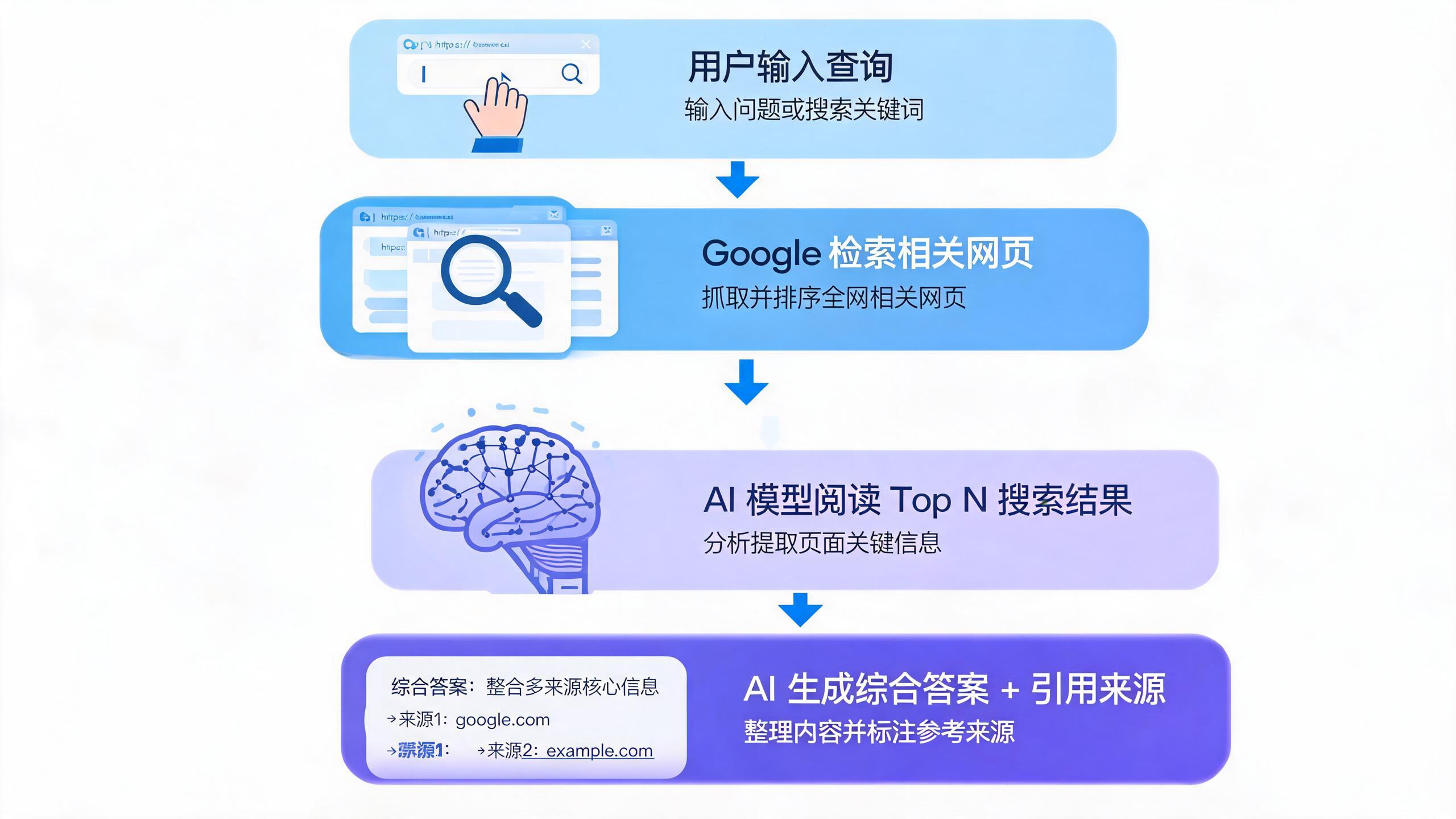
Figure: A flow diagram illustrating how Google AI Overview works
The key point: AI doesn’t generate answers out of thin air — it still relies on the content of web pages it has indexed. This means:
- You still need to rank well in traditional search first (usually the top 10 results have a chance of being cited by AI)
- But ranking well doesn’t guarantee citation — AI has its own content selection criteria
- Content cited by AI gains “brand exposure,” which has value even without clicks
What Kind of Content Does AI Prefer to Cite?
Based on research and testing from multiple SEO agencies, AI models tend to favor the following types of content when selecting citation sources:
| Content Feature | AI Preference | Description |
|---|---|---|
| Structured Data | ⭐⭐⭐⭐⭐ | Tables, lists, and FAQ formats are easy to extract |
| Data + Sources | ⭐⭐⭐⭐⭐ | Content with data and cited sources is more trustworthy |
| Original Depth | ⭐⭐⭐⭐ | Content with unique insights is more likely to be cited |
| High EEAT | ⭐⭐⭐⭐ | Content from authoritative websites and authors gets higher priority |
| Q&A Format | ⭐⭐⭐⭐ | Direct question-and-answer structures match AI’s response patterns |
| Concise & Clear | ⭐⭐⭐ | AI prefers bullet-point-style, easily extractable content |
| Brand Recognition | ⭐⭐⭐ | Well-known brands are more likely to be mentioned |
In short: AI favors content that is “easy to extract, highly credible, and clearly structured.”
The Five Core Strategies of AI SEO
Strategy One: Prioritize Structured Content
AI models process structured content far more efficiently than natural paragraphs. Content formatted as tables, lists, and step-by-step instructions is much easier for AI to extract and cite.
1.1 Use Tables for Comparisons and Data
For comparative and data-driven content, always present it in table form.
Bad Practice (long blocks of text):
The cost of CRM AI upgrades varies by solution. Salesforce Einstein is relatively expensive, starting at around $50 per user per month. Zoho Zia is more affordable and is included in the premium edition. Fxiaoke’s AI features are charged per module. Overall, enterprise edition costs range from tens of thousands to hundreds of thousands of dollars per year.
Good Practice (table):
| Product | AI Features | Starting Price | Suitable For |
|---|---|---|---|
| Salesforce Einstein | Lead scoring + forecasting + Copilot | From $50/user/month | Mid-to-large enterprises |
| Zoho Zia | Full-scenario AI assistant | Included in premium ($40/user/month) | SMEs |
| Fxiaoke | Smart assistant + contract review | Modular pricing, ~20%-30% premium | China market enterprises |
| HubSpot | Predictive scoring + AI content | From $800/month (Professional) | Growth-stage companies |
Why are tables easier for AI to cite?
- High information density — AI can extract multiple data points at once
- Clear structure — AI is less likely to misinterpret the content
- For comparison queries, table content has the highest match rate
1.2 Use Lists to Organize Key Points
For key points, steps, and checklists, use ordered or unordered lists.
Good Practice:
A technical SEO audit consists of seven steps:
- Crawlability check
- Indexing control
- Website speed optimization
- Mobile responsiveness
- Structured data
- HTTPS security
- Website architecture and internal linking
1.3 Front-Load Key Information
Like users, AI has limited attention. Put the most important information at the beginning of your article and at the start of each paragraph.
The Inverted Pyramid Writing Method:
- Lead with the core conclusion/answer
- Then expand with detailed explanation
- Finally, supplement with background and details
Strategy Two: Reinforce EEAT
EEAT (Experience, Expertise, Authority, Trust) has long been a critical factor in Google’s rankings. In the AI era, the importance of EEAT is further amplified — because AI models are more inclined to cite content from authoritative sources.
2.1 Make Author Information Transparent
Every article should have clear author information, including:
- Author name and avatar
- Author bio (professional background, years of experience)
- Author’s social media accounts (LinkedIn, Twitter, etc.)
- Other published articles
Why this matters: When AI models evaluate content credibility, they consider the author’s professional background. Content with clear author information is more likely to be judged as “high quality.”
2.2 Cite Data with Source Attribution
When citing data, always attribute the source.
Good Practice:
According to Gartner’s 2026 forecast, by 2028, spending on CRM software with Agentic AI capabilities will exceed spending on CRM software without it.
Bad Practice:
Apparently CRM AI is really hot right now, and the market size is pretty big.
Benefits of source attribution:
- Boosts content credibility (for both users and AI)
- AI is more inclined to cite content with data
- Builds a “data-driven content” brand impression
2.3 Cases + Real Data
Real-world cases and concrete data are powerful proof of EEAT.
- Customer cases (with specific company names, data, and results)
- Project metrics (not “significant improvement,” but “37% improvement”)
- Specific details such as time, location, and people involved
2.4 Third-Party Citations and Endorsements
Earning citations and mentions from authoritative third parties is the best way to boost authority:
- Media coverage
- Citations in industry research reports
- Recommendations from well-known blogs/experts
- Awards and certifications
Strategy Three: Optimize the Q&A Format
The core mode of AI search is “question and answer” — users ask in natural language, and AI provides an answer. If your content is already in Q&A format, the match rate will be very high.
3.1 FAQ Sections Are a Powerful AI SEO Tool
Adding an FAQ section at the end of every article is currently one of the highest-ROI AI SEO tactics.
FAQ Optimization Tips:
- Include 3-7 FAQs per article
- Use phrasing that users would actually search for
- Keep answers direct and concise, ideally 100-200 words
- Include core keywords in the answers
- Add FAQPage structured data (Schema)
FAQ Topic Discovery Methods:
- “People Also Ask” (PAA) boxes in Google search results
- Tools like AnswerThePublic / AlsoAsked
- Popular questions on Zhihu and Quora
- Questions customers frequently ask (collected by sales/customer service)
- Competitors’ FAQ pages
3.2 Q&A-Style Articles
Beyond FAQ sections, you can also write full Q&A-style articles targeting specific question keywords.
Q&A Article Template:
1 | Title: [Question]? Complete Answer + Case Analysis |
3.3 Natural Language Optimization
In AI search, user queries are becoming longer and more conversational. When optimizing content, pay attention to:
Complete sentences: Use full question sentences for titles and subheadings, not phrases
❌ “FDE pricing”
✅ “How does FDE service pricing generally work? What are the pricing models?”
Conversational language: Use a natural Q&A rhythm throughout your content
Colloquial expressions: Naturally incorporate phrases users commonly use
Strategy Four: Optimize Brand Mentions
In AI search, even without a click, having your brand mentioned in an AI-generated answer has value. This is called brand mention optimization.
4.1 Why Brand Mentions Matter
| Traditional Search | AI Search |
|---|---|
| High ranking = more clicks | Cited = brand exposure |
| Click → visit website → convert | Brand placement → mindshare → later branded search |
| Directly measurable | Indirect but with strong long-term value |
When users see your brand/product mentioned in an AI answer, even if they don’t click at that moment, an impression is left in their mind. When they later make a purchasing decision, they’re likely to search for your brand term directly.
4.2 Brand Mention Optimization Methods
1) Brand + Core Capability Combinations
Naturally incorporate “brand name + core capability” combinations in your content.
Example:
HyDe’s FDE (Forward Deployed Engineer) service is particularly well-suited for complex projects that require deep business understanding, such as AI upgrades and CRM transformations.
2) Embed Your Brand in Comparative Content
In comparison articles/tables, include your own product/service as one of the options.
3) Reinforce Your Brand in Cases and Data
Using “a certain company” is not as effective as using the real brand name (with proper authorization).
4) Unique Concepts/Methodologies
Create unique concepts or methodologies and name them after your brand. If AI cites this concept when answering related questions, it’s effectively free brand exposure.
Strategy Five: Optimize AI Citation Rate
The ultimate goal is to increase the probability that your content is cited by AI. Here are proven optimization techniques.
5.1 Eight Techniques to Increase Citation Probability
| Technique | Description | Difficulty |
|---|---|---|
| Tabularize Data | Present all comparisons and data in tables | ⭐ |
| Structured FAQs | Add FAQ + Schema to every article | ⭐ |
| Data + Sources | Cite authoritative data with source attribution | ⭐⭐ |
| Bold Key Sentences | Highlight core conclusions with bold or lists | ⭐ |
| Definitional Content | Provide clear definitions of concepts (AI loves citing definitions) | ⭐⭐ |
| Step-by-Step Guides | Present “how-to” content as steps 1/2/3 | ⭐⭐ |
| Unique Data/Research | Publish original research and exclusive data | ⭐⭐⭐⭐ |
| Authoritative Endorsements | Earn citations from well-known institutions or experts | ⭐⭐⭐⭐⭐ |
5.2 The Power of Definitional Content
When AI answers questions like “What is X?”, it strongly prefers to cite definitional content.
How to Write Great Definitional Content:
- The first sentence should be a clear definition
- Keep the definition concise and accurate (1-2 sentences)
- Then expand: characteristics, origin, classification, examples
- Add “the difference between X and Y”
Example:
FDE (Forward Deployed Engineer) is a delivery model where engineers are stationed directly at the client’s site or deeply embedded in the client’s team. Unlike traditional outsourcing, which ends once requirements are delivered, FDE emphasizes end-to-end continuous delivery — from requirement diagnosis and solution design through development, launch, and ongoing operations iteration — staying involved throughout to ensure the system actually runs and delivers business value.
The FDE model originated at Palantir and was later widely adopted by tech companies such as OpenAI and Stripe…
AI SEO vs. Traditional SEO
| Dimension | Traditional SEO | AI SEO |
|---|---|---|
| Core Goal | Ranking + clicks | Citation + brand exposure |
| Content Preference | Keyword optimization + length | Structured + data-driven + authoritative |
| Success Metrics | Rankings, traffic, CTR | Citation rate, brand mentions, AI Overview appearances |
| Content Format | Primarily long-form articles | Tables, lists, FAQs, definitions |
| EEAT Weight | High | Extremely high |
| Click-Through Rate | Core metric | Declining, but brand value rising |
| Optimization Cycle | 3-6 months | 2-4 months (content adjustments take effect faster) |
Key Insight: AI SEO doesn’t replace traditional SEO — it is an upgrade and extension of traditional SEO. The foundations of traditional SEO (technical optimization, content quality, backlink authority) remain important; only the content presentation methods and optimization priorities shift. You can first read the Enterprise SEO Complete Guide for a systematic overview.
AI SEO Opportunity Window Analysis
Now Is the AI SEO Bonus Period
According to multiple industry studies:
| Data | Source | Description |
|---|---|---|
| AI Overview coverage | 40%+ | Semrush 2026, U.S. market |
| Marketers prioritizing AI SEO | 43% | HubSpot 2026 survey |
| Companies actually executing AI SEO | 14% | Huge gap = huge opportunity |
| Zero-click rate in AI search | ~25% | Still 75% of searches generate clicks |
Why Now Is the Bonus Period:
- Most companies haven’t yet realized the importance of AI SEO
- Even fewer companies are actually executing it
- Early movers can quickly build an advantage
- AI models are still evolving, so early-optimized content creates a “first-mover advantage”
AI SEO Impact by Industry
| Industry | AI Overview Impact | Opportunity Size | Description |
|---|---|---|---|
| Knowledge/Education | 🔴 Very High | 🟡 Medium | High impact but also intense competition |
| Technology/Software | 🟠 High | 🟢 Large | Technical questions suit AI answers; B2B conversion paths are long |
| Finance/Legal | 🟠 High | 🟡 Medium | Strictly regulated; AI answers are more cautious |
| Healthcare | 🟠 High | 🔴 Small | Most strictly regulated; AI is reluctant to answer freely |
| E-Commerce/Retail | 🟡 Moderate | 🟢 Large | Many opportunities in product comparison queries |
| B2B Services | 🟢 Lower | 🟢 Very Large | Currently low impact, little competition, strong first-mover advantage |
B2B enterprise services is currently one of the best tracks for AI SEO — low competition, high commercial value, and long user decision chains (giving brand mentions ample time to convert).
90-Day AI SEO Action Plan
Month 1: Foundation Optimization
- Add FAQ sections to all existing articles (3-5 per article)
- Add FAQPage structured data
- Convert comparisons and data in articles to table format
- Review and improve author information
- Attribute sources for all core data points
Month 2: Content Upgrade
- Select 3-5 core articles for deep AI SEO optimization
- Add definitional content (“What is X”)
- Add step-by-step guide content (“How to do Y”)
- Publish 1-2 original data/research articles
- Monitor brand mentions in AI Overviews
Month 3: Expansion & Consolidation
- Cover more Q&A-type keywords (discovery methods covered in Keyword Research Methodology)
- Build a content matrix of brand + core capabilities
- Secure 2-3 third-party citations/endorsements
- Optimize comparison content and embed your brand
- Establish an AI SEO performance tracking system
Future Trends in AI SEO
1. From “Traffic Mindset” to “Attention Mindset”
Stop focusing solely on click-through rates and traffic; instead, pay attention to your brand’s exposure in AI answers and its share of mind.
2. The Bar for Content Quality Rises Further
AI can generate massive amounts of mediocre content, but unique insights, real cases, and exclusive data cannot be generated by AI. These will become increasingly valuable.
3. The Role of Brand Becomes More Important
Users trust well-known brands mentioned in AI answers more. The relationship between brand building and SEO will grow ever closer.
4. The Rise of Multimodal Search
Text → images → video → voice. AI search is evolving from pure text to multimodal. The importance of video SEO and image SEO will increase.
5. Agentic SEO
When AI Agents can automatically perform searches, filtering, and even placing orders, the optimization target of SEO will shift from “search engines” to “AI agents.” This is a longer-term trend.
Frequently Asked Questions
Q1: Now that AI search is here, is SEO still necessary?
Absolutely necessary. AI search hasn’t eliminated SEO — it has changed how SEO works. Just as when mobile search arrived, PC SEO didn’t become useless; it needed to evolve into mobile SEO. The core of SEO in the AI era is still “providing high-quality content”; only the presentation methods and optimization priorities have shifted. Companies that start laying the groundwork for AI SEO now will have a significant first-mover advantage over the next 2-3 years.
Q2: Will AI SEO be difficult? Do I need a technical background?
The core of AI SEO is content optimization, which doesn’t require a deep technical background. Most actions (adding FAQs, using tables, citing data sources, improving author information) are content-level tasks that editors and content teams can handle. The technical parts (structured data, page speed, etc.) are the same as in traditional SEO. In short: if you’re already doing traditional SEO, transitioning to AI SEO only requires adjusting 20%-30% of your content strategy on top of your existing work.
Q3: How do I measure the effectiveness of AI SEO?
Measuring AI SEO effectiveness is still evolving, with no unified standard yet. It’s recommended to track three types of metrics: 1) Brand mention metrics: the number of times your brand is mentioned in AI Overviews (requires manual or tool-based monitoring); 2) Branded search volume: changes in how often users search for your brand terms (from Search Console); 3) Traditional SEO metrics: rankings, traffic, conversions — these still matter because AI cites content that ranks well.
Q4: Can generative AI be used to produce SEO content?
Yes, but strategically. AI can help with drafting, organizing information, and optimizing formatting, but unique human insights and experience cannot be replaced by AI. If you simply let AI batch-generate content, it’s easily judged as low-quality by search engines. The best practice is an “AI + human” collaboration model: AI handles the foundational work (research, drafts, formatting), while humans handle the deep work (unique insights, case validation, quality control).
Q5: Is it necessary for small businesses to do AI SEO?
Absolutely — and small businesses actually have an advantage. Why? Because large companies react slowly, have long decision chains, and complex content approval processes — by the time they start doing AI SEO, small businesses have already seized the initiative. Moreover, what AI SEO values most is content quality and uniqueness, not budget size. A small blog with deep insights can absolutely be cited by AI more easily than a large corporate website with mediocre content.