Many enterprises are interested in FDE (Forward Deployed Engineer), but they all share a common question: How is an FDE project delivered? And how is it different from traditional outsourcing?
Everyone is familiar with the traditional outsourcing delivery process: requirements research → solution design → development → testing → go-live → acceptance. But the FDE model works completely differently — it emphasizes embedding, iteration, and outcome orientation, rather than progressing linearly through stages.
This article breaks down the standard FDE delivery process, from initial discovery to knowledge transfer, covering what happens in each stage, what is delivered, and how effectiveness is measured — to help you build a complete understanding.
Core Characteristics of the FDE Delivery Process
Before diving into the specific stages, let’s first understand the fundamental difference between FDE delivery and traditional delivery:
| Characteristic | Traditional Waterfall | FDE Model |
|---|---|---|
| Delivery approach | Linear — one stage finishes before the next begins | Iterative — every iteration forms a complete closed loop |
| Requirements management | Locked in up front; changes go through a formal process | Continuously evolving; can be adjusted every two weeks |
| Delivery frequency | One-time delivery at project completion | Demonstrable results every week |
| Acceptance method | Final acceptance against the requirements list | Continuous acceptance based on business outcomes |
| Customer participation | Discovery at the start + acceptance at the end, minimal involvement in between | Deeply involved throughout, with daily communication |
| Risk control | Scope fixed up front; risks are borne later | Small, fast steps; issues are caught and adjusted early |
In one sentence: Traditional outsourcing “delivers features against a contract,” while FDE “runs toward outcomes together with the customer.”
The Five Stages of the Standard Delivery Process
Stage 1: Discovery and Planning (Week 1)
This is the starting point of the project and also the most critical stage. The root cause of many failed projects is that discovery was not done thoroughly.
Core Tasks
| Task | Description | Participating Roles |
|---|---|---|
| Business current-state diagnosis | Deep understanding of current business processes, pain points, and goals | FDE + Business Owner |
| System current-state assessment | Existing system architecture, data landscape, technology stack | FDE + Technical Lead |
| Data quality assessment | Data completeness, accuracy, and accessibility | FDE + Data/Business Team |
| Success criteria alignment | Define the metrics by which project success is measured | FDE + Project Sponsor |
| Priority ranking | Determine what to do first and what to do later | FDE + Business + Technical |
| Risk identification | Identify potential risks and obstacles in advance | FDE + Customer Team |
Deliverables
- Current-State Diagnosis Report: Business process as-is, system as-is, and data quality assessment
- Project Proposal: Goals, scope, technical solution, and implementation plan
- Success Metrics Definition: Quantifiable success criteria (e.g., “increase lead conversion rate by 15%”)
- Risk Register and Mitigation Plan: Identified risks and corresponding countermeasures
Key Points
- You must get access to the decision-maker: Without decision-maker involvement, it will be very difficult to drive things forward later
- Success criteria must be quantified: Not vague statements like “improve efficiency” — there must be numbers
- Data is the core prerequisite: For AI projects especially, data quality must be assessed first — with poor data, even the best FDE cannot deliver results
- Don’t promise what can’t be done: A good FDE will tell you “what can and cannot be done” at this stage, rather than saying yes to everything
This stage is also commonly known as the “Discovery Week” — spend one week mapping out every aspect of the project, and only then decide whether to proceed and how.
Stage 2: Design and Prototyping (Week 2)
Once the diagnosis is clear, we move into the design and prototyping stage. The goal of this stage is: quickly build a demonstrable prototype to validate the feasibility of the solution.
Core Tasks
| Task | Description | Participating Roles |
|---|---|---|
| Detailed solution design | Architecture design, data flow design, interface design | FDE + Technical Team |
| Prototype development | Build a runnable prototype of the core functionality | FDE (customer technical team may participate) |
| Data access validation | Verify whether key data can be obtained and whether its quality is sufficient | FDE + Data Team |
| Prototype demo and feedback | Demo for the business team and collect feedback | FDE + Business Team |
| Solution adjustment and optimization | Adjust the solution based on feedback | FDE |
Deliverables
- Technical Solution Document: Architecture diagrams, data flow diagrams, and interface definitions
- Runnable Prototype: Demo version of the core functionality
- Data Access Plan: Data sources, access methods, and cleansing rules
- Iteration Plan: Iteration schedule for subsequent development
Key Points
- The prototype must really run: Not a PowerPoint mockup, but a clickable, runnable prototype that shows real data
- Use real data: Try to build the prototype with the customer’s real data rather than fake data — fake data looks nice but hides problems
- Iterate quickly: The prototype isn’t finalized in one version; it may go through 2–3 revisions
- Don’t pursue perfection: The purpose of a prototype is to validate direction, not to build the final product — make it usable; details can be refined later
After this stage, the customer can clearly see “roughly what the final product will look like” and decide whether to continue investing. This is an important decision point — if the prototype validation shows poor results, the project can be stopped early with minimal loss.
Stage 3: Development and Iteration (Weeks 3–5)
This is the main stage of the project, and also the stage where the FDE model differs most from traditional outsourcing.
Traditional outsourcing says “test everything together after development is complete,” while FDE follows “one iteration per week, with a complete development–testing–demo–feedback loop in each iteration.”
Iteration Cadence (Two-Week Cycle)
1 | Monday: Iteration planning meeting → decide what to build in this iteration |
Core Activities in Each Iteration
| Activity | Frequency | Participating Roles | Purpose |
|---|---|---|---|
| Daily stand-up | 15 minutes per day | FDE + Contact Person | Sync progress, surface blockers |
| Iteration planning | Once every two weeks | FDE + Business + Technical | Define iteration goals and tasks |
| Iteration demo | Once every two weeks | FDE + Business Team + Sponsor | Showcase results, collect feedback |
| Iteration retrospective | Once every two weeks | FDE + Core Team | Summarize lessons, improve process |
| Code review | Ongoing | FDE + Customer Technical Team | Ensure code quality, enable knowledge transfer |
Deliverables
Per iteration:
- Runnable Incremental Features: New features completed in this iteration
- Iteration Demo Record: Demo content, feedback, and action items
- Updated Documentation: Technical documentation, user manuals, etc.
End of entire stage:
- Complete Feature System: All planned features developed
- Test Report: Functional, performance, and security test results
- User Operations Manual: Usage guide for business users
- Operations Manual: Operations guide for the technical team
Key Points
- Small, fast steps with timely feedback: Don’t wait until “everything is done” to review — look at results every week
- Priorities can be adjusted: If the business side discovers a more important new need, the next iteration’s priorities can be reorganized
- Customer team must participate in development: It’s not the FDE coding alone in a silo; the customer’s technical team should join in code review and testing together
- Quality cannot be compromised: Fast iteration doesn’t mean poor quality — every iteration must include complete testing
The standard development cycle at FDE practices is 6 weeks to deliver an end-to-end AI workflow. Two weeks for discovery + prototyping, then four weeks for development + iteration. This cadence has been validated across a large number of projects — balancing speed with quality.
Stage 4: Go-Live and Validation (Week 6)
After development is complete, we enter the go-live and outcome validation stage.
For traditional outsourcing, go-live means “deploy it and you’re done.” For FDE, go-live means “it not only has to go live, it has to run and deliver results.”
Core Tasks
| Task | Description | Participating Roles |
|---|---|---|
| Production environment deployment | Deploy the system to the production environment | FDE + Operations Team |
| Data cutover/integration | Connect real data and verify data accuracy | FDE + Data Team |
| User training | Train business users on how to use the system | FDE + Business Owner |
| Pilot observation | Monitor runtime after go-live and address issues promptly | FDE + All |
| Outcome validation | Verify actual results against success metrics | FDE + Sponsor |
| Issue fixing and optimization | Fix issues based on pilot operation findings | FDE |
Deliverables
- Production-Ready System: Officially live and running
- Training Materials: Operations manual, video tutorials, FAQ
- Outcome Validation Report: Comparative analysis of actual results vs. expected goals
- Go-Live Issue Log and Fix Records: Issues found during go-live and how they were handled
Key Points
- Go-live is not the finish line, it’s the starting line: The first week after go-live is the most critical — monitor runtime closely
- Have a rollback plan: In case something goes wrong, be able to quickly revert to the old system
- User training must be thorough: No matter how good the system is, it’s useless if users don’t know how to use it
- Outcome validation must be objective: Let the data speak — don’t settle for “it feels pretty good”; check each success metric defined at the start of the project one by one
The core goal of this stage is to “ensure the system is genuinely usable, genuinely being used, and genuinely delivering results.” Many projects die at the stage of “it’s live but nobody uses it” — this is precisely where the value of the FDE model lies: go-live is not the end; meeting the success metrics is.
Stage 5: Knowledge Transfer and Handover (Weeks 6–8)
This is one of the biggest differences between the FDE model and traditional outsourcing.
Traditional outsourcing handover is “hand over code + hand over documents,” then goodbye. FDE knowledge transfer is “hand-holding teaching to ensure the customer team can maintain and iterate independently.”
Core Tasks
| Task | Description | Participating Roles |
|---|---|---|
| Code walkthrough | Explain code architecture and implementation logic module by module | FDE + Customer Technical Team |
| Operations training | Deployment, monitoring, alerting, troubleshooting | FDE + Operations Team |
| Iteration methodology training | How to continue iterating features using agile methods | FDE + Product/Technical Team |
| Documentation completion | Fill in all technical and operations documentation | FDE (customer team participates) |
| Handover acceptance | Confirm all knowledge and documentation have been delivered | FDE + Project Sponsor |
| Post-project support agreement | Determine the support model after project completion | FDE + Customer |
Deliverables
- Complete Codebase: Source code with standardized comments
- Comprehensive Technical Documentation: Architecture documents, interface documents, database documents, operations manual
- Knowledge Transfer Confirmation Checklist: Item-by-item confirmation of knowledge transfer completion
- Post-Project Support Plan: If needed, agreed support methods and fees
Three Layers of Knowledge Transfer
| Layer | Content | Importance |
|---|---|---|
| Layer 1: Artifacts | Code, documentation, tools | Foundation — a must-have |
| Layer 2: Method | How it’s done, why it’s done this way, how to troubleshoot | Core — determines whether independent maintenance is possible |
| Layer 3: Thinking | Decision-making rationale, trade-off logic, future evolution direction | Highest level — determines whether iteration can continue |
Many outsourcing projects only reach Layer 1. FDE projects aim for Layer 2, and excellent FDEs can achieve Layer 3.
Key Points
- Knowledge transfer starts on day one: Not done only at project end, but synchronized throughout the process
- Use “doing” instead of “telling”: Don’t just lecture — let the customer team do it themselves, with the FDE guiding alongside
- Use a handover checklist: Check item by item to ensure nothing is missed
- Leave a safety net: Agree on the support model after project completion, such as a one-month free support period or pay-per-hour on-call support
End-to-End Timeline Overview
Taking a standard 6-week FDE project as an example:
| Week | Stage | Core Outputs | Decision Point |
|---|---|---|---|
| Week 1 | Discovery and Planning | Current-state diagnosis report + project proposal + success metrics | Continue? Approve the solution? |
| Week 2 | Design and Prototyping | Runnable prototype + technical solution + iteration plan | Does the prototype meet expectations? Proceed to development? |
| Week 3 | Iteration Development 1 | First version of incremental features | — |
| Week 4 | Iteration Development 2 | Second version of incremental features, midpoint review | Need to adjust direction? |
| Week 5 | Iteration Development 3 | Complete features + test report | — |
| Week 6 | Go-Live and Validation | System go-live + outcome validation report | Are results up to standard? Accept the project? |
| Weeks 7–8 | Knowledge Transfer | Complete handover + knowledge transfer confirmation | Project officially closes |
Note: This is the standard 6-week delivery cycle (8 weeks total with 2 weeks of knowledge transfer). In practice, the cycle varies depending on complexity and scope. Simple scenarios may take 4 weeks, while complex projects may require 3–6 months.
Time Allocation by Stage
| Stage | Share of 6-Week Project | Share of 8-Week Project | Core Work |
|---|---|---|---|
| Discovery and Planning | ~17% (1 week) | ~12.5% (1 week) | Research, solution, goal alignment |
| Design and Prototyping | ~17% (1 week) | ~12.5% (1 week) | Prototype development, solution validation |
| Development and Iteration | ~50% (3 weeks) | ~37.5% (3 weeks) | Feature development, iterative optimization |
| Go-Live and Validation | ~16% (1 week) | ~12.5% (1 week) | Deployment, training, outcome validation |
| Knowledge Transfer | — | ~25% (2 weeks) | Code handover, training, documentation |
Consolidated Deliverables Checklist Across All Stages
| Deliverable Type | Discovery | Prototyping | Development | Go-Live | Handover |
|---|---|---|---|---|---|
| Documentation | |||||
| Current-state diagnosis report | ✅ | ||||
| Project proposal | ✅ | ||||
| Success metrics definition | ✅ | ||||
| Technical solution document | ✅ | Updated | |||
| User operations manual | Draft | ✅ Final | |||
| Operations manual | Draft | ✅ Final | |||
| Code | |||||
| Runnable prototype | ✅ | ||||
| Incremental feature code | Each iteration | ||||
| Complete production code | ✅ | ✅ Final | |||
| Automated tests | Continuously added | ✅ | |||
| CI/CD configuration | ✅ | ||||
| Validation | |||||
| Iteration demo records | Each iteration | ||||
| Test report | ✅ | ||||
| Outcome validation report | ✅ | ||||
| Knowledge transfer confirmation checklist | ✅ | ||||
| Training | |||||
| User training materials | ✅ | ||||
| Technical training (code walkthrough) | ✅ | ||||
| Operations training | ✅ |
Total: A complete FDE project delivers approximately 15–20 items, covering the full chain from solution to code, and from testing to training.
Cycle and Resource Allocation by Project Scale
FDE projects can be large or small. Below are typical configurations for different project scales:
| Project Scale | Typical Scenario | FDE Headcount | Total Duration | Discovery | Development | Go-Live + Handover | Suitable Customers |
|---|---|---|---|---|---|---|---|
| Small (Quick Validation) | Single-scenario AI pilot, e.g., AI customer service, lead scoring | 1 | 4–6 weeks | 1 week | 2–3 weeks | 1–2 weeks | SMEs, startups |
| Medium (Standard Delivery) | 2–3 linked scenarios, e.g., CRM AI upgrade | 1–2 | 8–12 weeks | 1–2 weeks | 5–7 weeks | 2–3 weeks | Mid-sized enterprises, large-enterprise department level |
| Large (System Transformation) | Multi-system integration + multi-scenario, e.g., full-process AI transformation | 2–3 | 3–6 months | 2–4 weeks | 2–4 months | 4–6 weeks | Large enterprises, group-level |
| Extra-Large (Full Transformation) | Enterprise-level AI transformation, multiple departments and systems | 3–5+ | 6–12 months+ | 1–2 months | 4–9 months | 1–2 months | Large groups, multinational enterprises |
Note: The above are standard references. The actual cycle depends on factors such as data foundation, system complexity, and customer collaboration. The worse the data, the older the systems, and the slower the collaboration, the longer the cycle.
Efficiency Advantages of Iterative Development
Why does FDE use agile iteration instead of waterfall? Because the iterative model has higher overall efficiency:
| Metric | Waterfall Development | FDE Agile Iteration | Improvement |
|---|---|---|---|
| Time to first usable feature | Project end (3–6 months later) | Week 2–3 | 80–90% earlier |
| Requirements change response time | 2–4 weeks (formal change process) | 1–3 days (done in the next iteration) | 80–90% shorter |
| Time to discover wrong direction | Mid-to-late project (large losses) | Checked every two weeks (small losses) | 5–10x faster loss mitigation |
| Customer engagement | Low (only at start and end) | High (weekly communication) | Significantly improved |
| Final product fit | 60–70% (requirements changed but weren’t tracked) | 85–95% (continuously adjusted throughout) | 20–30% improvement |
| Rework rate | 20–30% (problems found all at once at the end) | 5–10% (corrected promptly throughout) | 60–70% lower |
| Team morale | Low (no visible results for a long time) | High (sense of achievement every week) | Significantly improved |
Data sources: Aggregated from agile development industry research (Standish Group Chaos Report, Forrester Agile Benchmark) and FDE project practice data.
For AI projects, where requirements are highly uncertain, the iterative model’s advantages are even more pronounced — waterfall AI projects have a failure rate of over 70%, while the agile iterative model can achieve a success rate of over 80%.
Roles in an FDE Project
A typical FDE project requires the following roles:
Customer-Side Roles
| Role | Responsibilities | Time Commitment |
|---|---|---|
| Project Sponsor | Decision-making, resource coordination, outcome acceptance | 1–2 hours per week |
| Business Owner | Requirements liaison, business confirmation, user coordination | 5–8 hours per week |
| Technical Contact | System integration, data access, technical communication | 5–10 hours per week |
| End-User Representative | Testing, feedback, training participation | 2–4 hours per week |
FDE-Side Roles
| Role | Responsibilities | Notes |
|---|---|---|
| FDE Lead | Overall project responsibility, solution design, key development | At least 1 per project |
| FDE Engineer | Hands-on development, integration, testing | Sized to project scale |
| Technical Advisor (as needed) | Expert support in specific domains | E.g., AI algorithm specialist, security specialist, etc. |
Collaboration Model
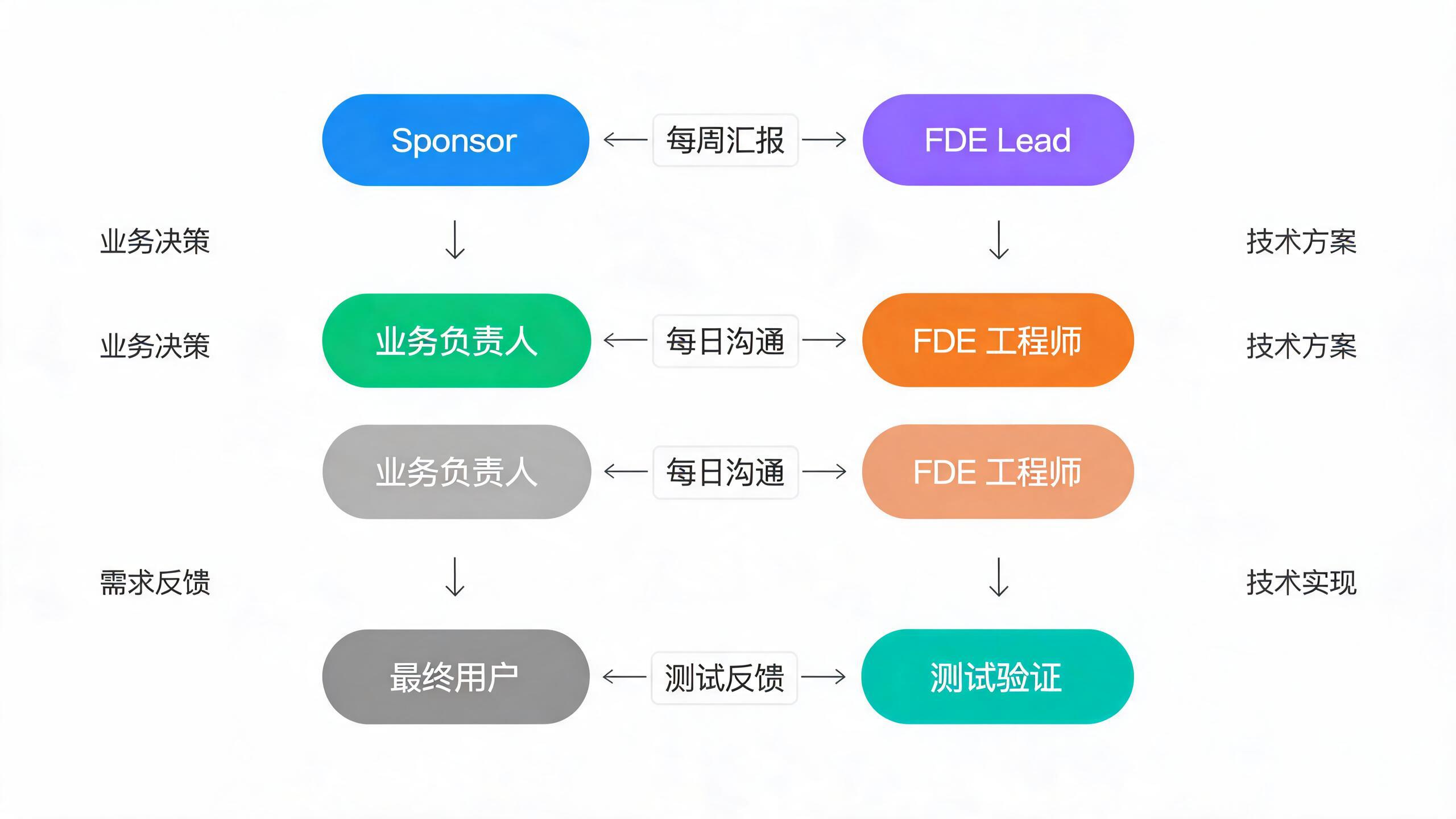
Figure: Three-layer collaboration and communication model for FDE projects
Key Success Factors for FDE Projects
Based on lessons learned from a large number of projects, FDE project success depends on several key factors:
1. The Customer Has a Clear Sponsor with Decision-Making Authority
This is the single most important factor. Without decision-maker support, even the most capable FDE cannot drive things forward. The Sponsor doesn’t need to be involved every day, but must be able to make decisions and coordinate resources at critical moments.
2. Data and System Access Are Cleared Up Front
Especially for AI projects, data is the foundation. Before the FDE comes on board, data permissions, system access, and API interfaces must be coordinated in advance. Otherwise, the first week will be entirely spent on approval processes with nothing getting done.
3. The Contact Person Is Reliable and Has Time to Invest
The FDE is not here to “do it for you” — they are here to “do it together with you.” If the customer’s contact is always busy with other things and hard to reach, the project will definitely not move fast.
4. Success Criteria Are Clear and Aligned Between Both Parties
Before the project starts, make it clear “what counts as success.” The more specific the better — for example, “after lead scoring goes live, sales follow-up efficiency improves by 20%,” rather than “improve sales efficiency.”
5. A Trusting and Transparent Communication Culture
The FDE model is built on trust. The customer must trust the FDE’s professional capability, and the FDE must be transparent with the customer — speak up promptly when difficulties arise, don’t hide them until the very end.
Common Pitfalls and How to Avoid Them
FDE Project Risk Matrix
In project management, risk = probability of occurrence × impact. Below are the most common risks in FDE projects and how to respond:
| Risk | Probability | Impact | Risk Level | Mitigation Strategy | Responsible Stage |
|---|---|---|---|---|---|
| Poor data quality prevents model performance | High | High | 🔴 Critical | Run data diagnosis in week 1; if data is insufficient, govern data first rather than forcing ahead | Discovery |
| Scope creep — scope keeps growing | High | Medium | 🟠 High | Define priorities per iteration; add new requirements to the backlog; review scope every two weeks | Full lifecycle |
| Users don’t adopt the system | Medium | High | 🟠 High | Involve users from day one; find seed users; demonstrate results with data | Full lifecycle |
| Contact person has no time; poor communication | Medium | Medium | 🟡 Medium | Agree on communication cadence up front; Sponsor drives resource allocation | Discovery + Development |
| Slow permission approval delays progress | High | Low | 🟡 Medium | Coordinate permissions before onboarding; run in parallel to avoid blockages | Discovery |
| Inadequate knowledge transfer; nobody can maintain after handover | Medium | High | 🟠 High | Start knowledge transfer on day one; use a checklist for item-by-item confirmation; include a warranty period | Handover |
| Key person leaves; project interrupted | Low | High | 🟡 Medium | FDE organization has backup mechanism; complete documentation enables quick handover | Full lifecycle |
| Results fall short of expectations; acceptance is difficult | Medium | Medium | 🟡 Medium | Quantify and align success metrics up front; validate continuously throughout; adjust in time | Go-Live |
Risk level legend: 🔴 Critical (requires focused attention and advance prevention) | 🟠 High (develop a mitigation plan) | 🟡 Medium (monitor regularly)
FDE Agile Delivery vs. Traditional Waterfall Delivery: A Head-to-Head Comparison
Many people ask: How does the FDE process differ from traditional project management? One table says it all:
| Dimension | Traditional Waterfall | FDE Agile Delivery |
|---|---|---|
| Delivery approach | Linear: research → design → develop → test → go-live, step by step | Iterative: each iteration is a complete develop–test–demo loop |
| Requirements management | Locked in up front; changes go through a formal process, costing more time and money | Continuously evolving; priorities can be adjusted every two weeks; flexible response to change |
| Delivery cadence | All features delivered at once at project end | Demonstrable results every week; incremental delivery every two weeks |
| Customer participation | Discovery up front + mid-project reviews + acceptance at end; limited involvement in between | Deeply involved throughout; daily stand-ups, bi-weekly demos |
| Acceptance criteria | Against the requirements list — passing if features are built | Against business metrics — passing if results meet targets |
| Risk control | Scope fixed up front; problems only found later, with large losses | Small, fast steps; checked every two weeks; adjusted early to cut losses |
| Documentation volume | Document-heavy — tens or hundreds of pages of requirements and design docs | Lightweight documentation — enough is enough; the code and the running system are the best documentation |
| Team collaboration | Clear division of labor, each does their own job; communication goes through process | Close collaboration; FDE and customer team work together |
| Change cost | The later the change, the higher the cost (exponential growth) | Change cost is relatively stable; can be adjusted at any time |
| Applicable scenarios | Standardized projects with very clear requirements | Exploratory projects with dynamic requirements (AI, innovation projects) |
| Failure mode | “All or nothing” — you only know if it works at the very end | “Progressive” — discover early and adjust early; at worst there are partial results |
| AI project fit | ⭐⭐ Very low | ⭐⭐⭐⭐⭐ Best |
The essence of the core difference: Waterfall assumes “requirements are certain; success comes from executing the plan as intended”; FDE agile assumes “requirements are uncertain; they need to be continuously explored and adjusted throughout the process.”
For AI projects, the latter is clearly closer to reality.
Phenomenon: As the project progresses, more and more requirements pile up, the scope keeps growing, and the timeline keeps slipping.
How to avoid:
- Define priorities for each iteration and only work on the highest-priority items
- Put new requirements into the backlog and evaluate them in the next iteration
- Review scope every two weeks to ensure alignment with goals
- Remember: fewer, well-crafted features are more valuable than many rough ones
Pitfall Two: Poor Data Quality
Phenomenon: Model performance is poor, and after investigation the root cause turns out to be bad data.
How to avoid:
- Run a data quality assessment in week 1, don’t wait until the development stage to find out
- If data quality is poor, do data governance first, then talk about AI
- Manage expectations — garbage in, garbage out is a law, not something an FDE can solve
Pitfall Three: Users Don’t Adopt or Use the System
Phenomenon: The system is built, but the business team doesn’t use it — which means it was built for nothing.
How to avoid:
- Involve user representatives from day one, rather than pushing the system on them only after it’s built
- Provide thorough training and patiently answer questions
- Find “seed users” — get a group of people using it first to create a demonstration effect
- Demonstrate results with data — when users see it genuinely saves them time and effort, they’ll naturally accept it
Pitfall Four: Inadequate Knowledge Transfer
Phenomenon: After the FDE leaves, nobody can maintain the system, and it gradually falls into disuse.
How to avoid:
- Start knowledge transfer on day one, not just at the end
- The customer’s technical team participates in development throughout, not only seeing the code at handover
- Use a detailed handover checklist and confirm item by item
- Include a 2–4 week “warranty period” with remote FDE support to ensure a smooth transition
Closing Thoughts
The FDE delivery process is both complex and simple.
Complex because: it requires the FDE to possess comprehensive capabilities across technology, business, communication, and project management; it requires deep collaboration with the customer team; it requires continuous iteration amid uncertainty.
Simple because: the core logic is just one thing — stand in the customer’s shoes, take responsibility for outcomes, and get it done.
Traditional outsourcing’s logic is “act according to the contract” — I do what’s in the contract, and I don’t touch what isn’t. FDE’s logic is “act according to outcomes” — whatever it takes to achieve the goal, do it.
These are two completely different mindsets, and this is the fundamental reason the FDE model is becoming increasingly popular.
📚 FDE Series Articles
| Article | Core Content |
|---|---|
| Complete Guide to FDE (Forward Deployed Engineer) | Role definition, value, capability model, and pricing model fully analyzed |
| FDE vs. Traditional Outsourcing vs. In-House Team: Deep Comparison and Selection Guide | A comprehensive comparison of three models to help you choose the right delivery approach |
| FDE Project Delivery Process (this article) | Breakdown of the standard delivery process — what happens and what is delivered in each stage |
| Why Do AI Projects Need FDE? Avoiding 70% Implementation Failure | Core pain points of AI implementation and how FDE solves them |
❓ Frequently Asked Questions
Q1: Why is an FDE project 6 weeks? Can it be faster?
6 weeks is the standard cycle for “single-scenario AI implementation” summarized by FDE practices — 1 week discovery + 1 week prototype + 3 weeks development + 1 week go-live validation. Can it be faster? Depends on project complexity. Simple scenarios (e.g., integrating one AI API) can be done in 2–3 weeks; complex scenarios (e.g., a complete CRM AI upgrade) may take 2–3 months. The key is not to chase speed, but that every stage has clear deliverables and decision points, allowing the customer to choose to continue, adjust, or stop at any time.
Q2: What if halfway through we find the direction is wrong?
This is precisely the advantage of the FDE model — early loss mitigation. A bi-weekly iteration retrospective lets you assess whether the direction is correct. If you find the direction is wrong, you can immediately adjust or even terminate the project. The loss is only 2–4 weeks of time and cost, not the massive loss of traditional outsourcing where “after six months you discover everything was wrong.” A good FDE will proactively tell you “this direction might be wrong, should we try a different approach?” rather than blindly pushing through to the end.
Q3: How much manpower does the customer need to invest in an FDE project?
Depends on project size and stage. For a standard 6-week project: the Business Owner invests about 5–8 hours per week, the Technical Contact about 5–10 hours per week, and the Sponsor about 1–2 hours per week. In total it’s roughly “half a person’s” workload. This investment is worthwhile — the more the customer invests, the better the project outcome and the more thorough the knowledge transfer. If the customer completely hands off, what the FDE builds is likely to not match actual needs.
Q4: How is an FDE project accepted? By what criteria?
Unlike traditional outsourcing, which accepts against a “feature list,” FDE projects are accepted against “business outcomes.” Quantified success metrics must be defined at the start of the project, such as “increase lead conversion rate by 15%,” “reduce customer service response time by 50%,” or “shorten contract review time from 2 days to 2 hours.” After go-live, run for 2–4 weeks and compare real data against the metrics — meeting them means passing. Of course, feature completeness is part of acceptance, but the core is outcomes, not the feature list.
Q5: After the project ends, what if there are new requirements?
Several options: first, continue cooperating on a “per person-day/hour” basis — call in the FDE for a few days when needed; second, a “subscription model” — a fixed number of FDE days per month for continuous iteration; third, a “new project model” — treat new requirements as an independent FDE project. Many enterprises choose the subscription model — it’s like having a senior expert on call, available when needed with no waste when not.
If you’d like to learn about the specific delivery arrangements for an FDE project, or assess whether your project is a good fit for the FDE model, feel free to get in touch.