Many enterprises launch AI projects—money gets spent, models get running—but the business never actually benefits.
Data shows that 70% of enterprise AI projects stall at the PoC (Proof of Concept) stage and never make it into production. Where does the problem lie? It’s not that the models aren’t good enough—it’s that the last mile has no one to walk it. AI lab engineers understand technology but not business; business teams understand requirements but not technology. There’s a huge gap in between.
FDE (Forward Deployed Engineer) exists precisely to bridge this gap.
This role was first created by Palantir in 2010, originally to serve government and defense clients. The explosion of large language models in 2023 and the surge in AI implementation demand pushed FDE into the mainstream. 2025 became a critical inflection point: OpenAI invested $4 billion to launch its Deployment Company, and Anthropic partnered with Blackstone to set up a $1.5 billion joint venture—elevating FDE from a functional role to a strategic business unit.
The Explosive Growth of the FDE Market
FDE is evolving from a niche role into one of the hottest technical positions in the AI era:
| Metric | 2024 | 2025 | 2026 (YTD) | Growth Rate |
|---|---|---|---|---|
| U.S. FDE job openings | ~140 | ~1,260 | Est. 2,400+ | 729% growth in 12 months |
| LinkedIn FDE positions | ~400 | ~3,600 | Continuing to grow | 800% year-over-year |
| Indeed active FDE jobs | 643 (Apr 2025) | — | 5,300 (Apr 2026) | 7.3x growth in one year |
| FDE median salary (U.S.) | ~$145K | ~$174K | ~$238K | 64% growth in two years |
Source: Indeed, Perspective AI, Bloomberry, LinkedIn public data, 2026
For comparison, over the same period ML Engineer roles grew by roughly 50%, Software Engineer roles by ~20%, and AI Researcher roles by ~30%. FDE’s growth rate is 10–30x that of other technical positions.
This is not a new concept, but as the challenges of AI implementation become increasingly apparent, its value is being rediscovered. This article systematically breaks down FDE’s role definition, core value, competency model, pricing models, and applicable scenarios, helping you determine whether FDE is the answer you need.
What Is FDE?
FDE (Forward Deployed Engineer) is a senior software engineer embedded directly within the client’s organization, responsible for taking AI/software products from prototype to production and delivering business value end to end.
There are several key terms in this definition:
- Forward Deployed: not writing code remotely, but going deep into the client’s front lines and working alongside the business team
- Engineer: not a consultant who only builds PowerPoint decks, but someone who can write code, ship to production, and solve real technical problems
- End-to-End Delivery: responsible for the entire process from requirement diagnosis through development, launch, and operations—rather than handing over code and walking away
Palantir defines FDE as: “Working shoulder-to-shoulder with the client’s senior teams to rapidly prototype and deliver high-impact solutions that drive measurable business impact from day one.”
Deloitte puts it more plainly: “FDEs don’t just build AI solutions—they help clients translate their AI vision into tangible business outcomes.”
A Typical Day for an FDE
| Time | Work |
|---|---|
| Morning | Stand-up with the client’s business team to understand current pain points and requirement priorities |
| Midday | Writing code—could be data pipelines, feature modules, or model integrations |
| Afternoon | Coordinating with the client’s IT/data team on system integration, permission configuration, and data connectivity |
| Evening | Code review, deployment testing, preparing the next day’s demo |
Compared with a pure backend engineer, an FDE spends 30%–50% of their time on communication, alignment, and demos. Compared with a pure consultant, an FDE spends 50%–70% of their time writing code, doing integrations, and running systems.
An FDE is a hybrid of “half engineer + half consultant,” but both sides need to go deep enough.
What Problems Does FDE Solve?
Problem 1: The “PoC Valley of Death” for AI Projects
70% of enterprise AI projects get stuck at the prototype stage and never make it to production. The reasons are complex:
- Models perform well on lab data but fall apart when connected to real business data
- After the demo is built, no one knows how to integrate it into existing systems
- The business team feels “this isn’t what I wanted,” while the technical team feels “the requirements keep changing”
- Vendors pull out after delivery, leaving behind a pile of unmaintained code
FDE’s solution: Go deep into the client’s business front lines, validate with real data and real scenarios from day one, build and adjust iteratively, and ensure what’s built is something the business can actually use.
Problem 2: Traditional Outsourcing’s “Delivery Equals End”
The traditional software outsourcing model is: client submits requirements → vendor quotes → contract signed → development → delivery → project closed. The problems are:
- Requirements are locked into the contract, but the business keeps changing
- Once delivered, the outsourced team leaves and there’s no one for subsequent maintenance
- The outsourced team is only responsible for “the features in the contract,” not for “business outcomes”
- Knowledge is entirely retained by the outsourcing company; the client’s team learns nothing
FDE’s solution: Not “build and deliver,” but “stay with it until it’s running.” FDEs are accountable for the final business outcome, not just the feature checklist. And during delivery, FDEs transfer knowledge, tools, and operational methods to the client’s team.
Problem 3: In-House Teams “Can’t Learn It, Can’t Get It Done”
Many enterprises want to hire their own people to do AI, but face practical difficulties:
- Top AI talent is hard to recruit and retain, with extremely high salary costs
- Even when hired, people need time to understand the business and get up to speed on the systems
- After the project is done, what do these people do? You can’t just disband them
- A single project can’t sustain a full AI team
FDE’s solution: Equivalent to “renting” a senior team for a period of time. Once the project is done and knowledge transfer is complete, there’s no need to keep people on the payroll long term. Lower cost, faster startup, lower risk.
Core Value of FDE
Value 1: Speed—From “Quarters” to “Weeks”
Traditional software project: requirement review 2 weeks → solution design 2 weeks → development 4 weeks → testing 2 weeks → launch 2 weeks = at least 3 months.
FDE model: Week 1 on-site research → Week 2 prototype → Weeks 3–4 iterative development → Week 6 launch and delivery.
FDE agencies (FDE service firms) have a standard delivery cycle of 6 weeks—from a real AI workflow prototype to production deployment in 6 weeks. Why so fast? Because FDEs are senior engineers who get hands-on directly, with no layers of reporting to go through and no lengthy processes—when they spot a problem, they fix it on the spot.
Value 2: Outcomes—Accountable for Business Results
Traditional outsourcing is accountable for “feature delivery”; FDE is accountable for “business outcomes.”
Take CRM AI upgrade as an example:
- Traditional outsourcing: gets the AI scoring feature built and launched, then closes the project. Whether people use it or how well it works is not their concern.
- FDE: not only builds it in, but ensures the sales team actually uses it and that lead conversion rates genuinely improve. If results aren’t good, they keep tuning until they are.
These are two completely different billing logics: one charges by “workload,” the other charges by “value.”
Value 3: Knowledge Transfer—Teaching a Man to Fish
FDEs are not here to replace the client’s team, but to “empower” them.
During the project, FDEs will:
- Hand over complete code, documentation, and evaluation methods to the client’s team
- Train the client’s engineers on how to maintain and iterate
- Establish operational processes and monitoring/alerting
- Leave behind reusable templates and best practices
At the end of the project, the client’s team doesn’t receive a “black box”—they own a system and a set of capabilities they can maintain and iterate on themselves.
Value 4: Risk Control—Small Steps, Fast Cuts
Traditional projects face “waterfall” risk: if requirements are defined wrong early on, it’s only discovered much later, and the losses are huge.
The FDE model is “agile”: deliver demonstrable results every week, conduct a value assessment every two weeks. If the direction turns out to be wrong, adjust immediately to avoid sinking more resources.
For enterprises, this means lower trial-and-error costs: spending 6 weeks to validate whether an AI scenario works is far less risky than spending 6 months on a big project only to find it useless.
FDE Competency Model: What Does a Qualified FDE Need?
An FDE is neither an ordinary engineer nor an ordinary consultant. It requires “T-shaped” capabilities—broad enough knowledge across domains, deep enough technical expertise.
| Competency Dimension | Specific Requirements | Why It Matters |
|---|---|---|
| Full-Stack Development | Comfortable with frontend, backend, database, DevOps | Front-line environments are complex with no full team backup—you need a bit of everything |
| AI/ML Engineering | Model integration, data pipelines, evaluation frameworks, prompt engineering | AI projects are FDE’s main battleground—you can’t implement without understanding AI |
| Business Understanding | Quickly grasp the client’s business processes and pain points | Only by understanding the business can you connect technology to business outcomes |
| Communication & Coordination | Communicate effectively from C-level to front-line staff | Aligning requirements, driving decisions, training users—communication is core work |
| Problem Diagnosis | Quickly locate problems and propose solutions | New issues arise on the front line every day—you can’t wait for HQ support for everything |
| Project Management | Prioritization, schedule control, risk identification | No one manages the project for you—you have to manage yourself |
| Resilience Under Pressure | Handle change and uncertainty | Client requirements change, systems break, plans get adjusted—keep your composure |
FDE vs. Traditional Engineer vs. Consultant
| Dimension | Traditional Software Engineer | FDE | Consultant |
|---|---|---|---|
| Core Output | Code/features | Business outcomes/running systems | Solutions/reports/recommendations |
| Work Location | In-house | Client site / embedded | Primarily client site |
| Coding Time Share | 70–90% | 50–70% | 10–30% |
| Communication Time Share | 10–30% | 30–50% | 70–90% |
| Accountability | Accountable for technical quality | Accountable for business outcomes | Accountable for solution quality |
| Knowledge Transfer | Usually not involved | One of the core deliverables | Exists but methodology-heavy |
| Compensation Level | Baseline | 10–20% higher than peers | Usually higher but less coding |
Data reference: FDEs typically earn 10–20% more than software engineers at the same level, reflecting the additional client-facing requirements and broader scope of responsibility.
Global FDE Salary Reference (2026 Data)
| Region / Company Type | Junior (0–2 yrs) | Mid (3–6 yrs) | Senior (7+ yrs) | Staff/Principal |
|---|---|---|---|---|
| U.S. - Palantir FDSE | ~$171K | ~$211K | ~$295K | $400K+ |
| U.S. - AI Labs (OpenAI/Anthropic) | ~$250K | ~$485K | ~$785K | $1.2M+ |
| U.S. - General Tech Companies | ~$130K | ~$175K | ~$240K | $320K+ |
| India | ₹18–28 LPA | ₹28–55 LPA | ₹55–90 LPA | — |
| Australia | AUD $130K | AUD $175K | AUD $220K+ | — |
| China (estimated) | 300K–500K RMB | 500K–800K RMB | 800K–1.5M RMB | 1.5M+ RMB |
Source: Levels.fyi, Perspective AI (n=423), BuildFastWithAI, ClavePrep, 2026
Note: Salaries are total compensation (base + bonus + equity). China market figures are industry estimates; AI-focused FDEs generally earn 20–50% more than those in traditional software roles.
FDE vs. Related Role Salary Comparison
| Role Type | U.S. Median Salary | vs. Peer SWE | Coding Time Share |
|---|---|---|---|
| Software Engineer (SWE) | $160K | Baseline | 70–90% |
| Forward Deployed Engineer (FDE) | $195K | +10–20% | 50–70% |
| Solutions Engineer (SE) | $150K | -15% ~ -30% | 10–30% |
| Technical Consultant | $210K | +25% ~ +35% | 5–15% |
| ML Engineer | $200K | +15% ~ +25% | 60–80% |
FDE’s compensation sits between software engineers and technical consultants, but its coding volume is far higher than consultants and its business involvement far higher than pure engineers—it’s a dual-value role combining “technology + business.”
FDE Applicable Scenarios: What Kinds of Projects Suit FDE?
FDE is not a panacea. It works well in some scenarios and not so well in others.
✅ Best-Fit Scenarios for FDE
| Scenario | Why It Suits |
|---|---|
| AI Implementation Projects | The core challenge of AI implementation is “the last mile”—exactly FDE’s strength |
| System Upgrade & Modernization | Requires deep understanding of existing systems + business processes, building and adjusting iteratively |
| Greenfield Projects (0 to 1) | Direction is uncertain, needs rapid validation and quick iteration |
| Capability Augmentation | In-house team lacks expertise in a specific area (e.g., AI, big data) |
| Digital Transformation | Needs external perspective + implementation capability to drive internal change |
| Urgent Projects | Needs fast startup and fast delivery, no time to hire slowly |
❌ Less-Suitable Scenarios for FDE
| Scenario | Why It Doesn’t Suit |
|---|---|
| Large-Scale Standardized Development | E.g., a 50-person outsourcing project—FDE model costs too much |
| Pure Maintenance Work | Day-to-day bug fixes and ops support—using FDE is wasteful |
| Very Clear and Fixed Requirements | Traditional outsourcing may be cheaper |
| Pure Strategy Consulting | For projects that don’t require code delivery, management consulting is more appropriate |
Fit by Enterprise Size
| Enterprise Size | Fit | Typical Usage |
|---|---|---|
| Large Enterprises | ⭐⭐⭐⭐⭐ | Has in-house team but lacks AI experts; FDE embeds to mentor and accelerate implementation |
| Mid-Size Enterprises | ⭐⭐⭐⭐⭐ | Wants AI upgrade but can’t sustain a full team; FDE is the optimal solution |
| Small Enterprises | ⭐⭐⭐ | Limited budget; can choose lightweight FDE services (e.g., remote FDE, daily-rate billing) |
| Startups | ⭐⭐ | Useful for rapid early-stage product iteration, but long-term should build an in-house team |
FDE Pricing Models
FDE pricing is far more flexible than traditional outsourcing. Common models include:
| Model | Billing Method | Applicable Scenario | Risk Allocation |
|---|---|---|---|
| Per Person-Day / Person-Month | Fixed daily/monthly fee | Unclear requirements, exploratory projects | Client bears primary risk |
| Fixed-Fee Project | Total project price, phased payments | Projects with relatively clear requirements | Both parties share risk |
| Outcome-Based | Base fee + outcome share | Projects with clear business targets (e.g., conversion uplift) | FDE bears more risk |
| Subscription / Long-Term On-Site | Monthly fee, long-term partnership | Continuously iterating projects (e.g., ongoing AI capability upgrades) | Long-term collaboration, shared risk |
Price Range Reference
| Model | China Price Range | Notes |
|---|---|---|
| Per person-day (senior FDE) | 3,000–8,000 RMB/day | Depends on experience and domain expertise |
| Per person-month (senior FDE) | 50,000–150,000 RMB/month | Long-term partnerships usually get discounts |
| Fixed-fee project | 150K–500K RMB/project | 6–8 week standard delivery cycle |
| AI implementation project | 200K–800K RMB/scenario | End-to-end implementation including model integration + business integration + outcome validation |
Note: The above are market reference ranges; actual prices vary by FDE experience level, project complexity, and industry. AI-focused FDEs generally command higher prices than those in traditional software roles.
FDE vs. Other Models
FDE vs. Traditional Software Outsourcing
| Dimension | Traditional Outsourcing | FDE |
|---|---|---|
| Relationship | Client-vendor, adversarial | Partners, win-win |
| Goal | Deliver features per contract | Achieve business outcomes |
| Location | Outsourcing company office | Embedded in client team |
| Communication | Through project manager | Directly with business and technical teams |
| Iteration Speed | Slow (changes go through process) | Fast (fix issues immediately when found) |
| Knowledge Transfer | Weak (delivery documentation) | Strong (mentoring + training + documentation) |
| Risk | Client bears most risk | Shared risk |
| Best For | Standardized projects with clear requirements | Innovative projects with dynamic requirements |
FDE vs. In-House Hiring
| Dimension | In-House Hiring | FDE |
|---|---|---|
| Startup Speed | Slow (recruitment 2–6 months) | Fast (onboard in 1–2 weeks) |
| Cost Structure | Fixed cost (monthly salary + benefits + management) | Variable cost (per-project payment) |
| Breadth of Capability | Limited to who you hire | Can select FDEs with different expertise on demand |
| Flexibility | Low (easy to hire, hard to let go) | High (ends when project ends) |
| Knowledge Retention | Knowledge leaves when people leave | Knowledge transferred to the whole team |
| Best For | Long-term stable business needs | Phased projects, capability augmentation |
FDE vs. Management Consulting
| Dimension | Management Consulting | FDE |
|---|---|---|
| Output | PowerPoint reports, recommendations | Running systems, actual business change |
| Implementation | Gives advice, not responsible for execution | Not only gives the plan, but builds it with their own hands |
| Team Composition | MBAs, industry experts | Senior engineers, AI experts |
| Cost | High (top-tier firms charge premium rates) | Medium-high |
| Best For | Strategic planning, organizational change | Technical implementation, system building |
How to Decide Whether Your Enterprise Needs FDE?
Self-Diagnosis Checklist
If you answer “yes” to 3 or more of the following questions, FDE may be a good choice for you:
- We have AI/software projects stuck at the prototype stage, unable to reach production
- We want to do digital upgrade but lack relevant technical experts in-house
- Previous outsourcing projects didn’t work well—delivered but never adopted
- We have an urgent project that needs to start fast and show results quickly
- We want to validate a new direction but aren’t sure it’s worth committing a large team
- The in-house team has basics but needs expert mentoring for a period
- We’ve tried doing AI ourselves but the results weren’t ideal
Decision Path
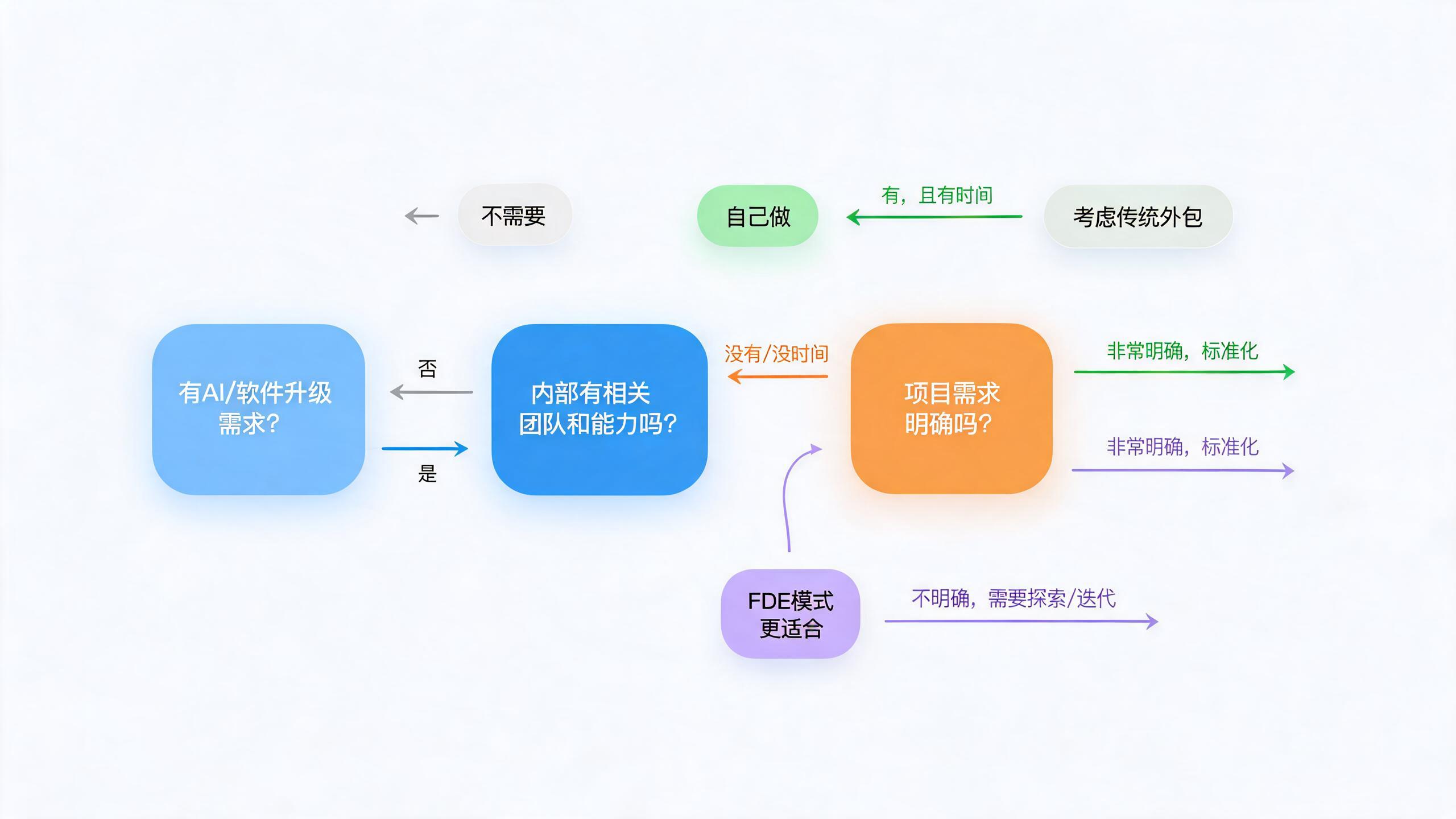
Figure: Delivery model decision tree for enterprise AI/software upgrade projects
Key Success Factors for FDE Projects
1. Client Must Have a Clear Sponsor and Point of Contact
No matter how capable an FDE is, they need someone inside the client to drive things. There must be a decision-making sponsor, plus day-to-day business and technical contacts. Otherwise, the FDE won’t even know who to go to for requirement confirmation.
2. Data and System Permissions Must Be Set Up in Advance
Data is the core of AI projects. Before the FDE comes on site, data access, system permissions, and API permissions need to be coordinated in advance. Otherwise, the FDE will spend the entire first week stuck in approval workflows with nothing to do.
3. Maintain High-Frequency Communication, Move in Small Steps
At least one stand-up per week, a results demo every two weeks. Don’t wait until “it’s done” to review—by then, if it’s wrong, more time has been wasted. The advantage of the FDE model is speed and flexibility—make the most of it.
4. Define Success Criteria and Acceptance Methods Clearly
Before the project starts, make it clear: what counts as success? How is it measured? How is it accepted? Is it about features going live, or about business metrics improving? The more specific, the better—avoid disputes later.
5. Prioritize Knowledge Transfer, Don’t Depend on Individuals
Conduct knowledge transfer throughout the project, not just at handover. Code standards, architecture design, operational processes, monitoring/alerting—all of these should be progressively transferred to the client’s team during the project, ensuring the system keeps running after the FDE leaves.
Future Trends for FDE
Trend 1: AI Drives Explosive FDE Demand
In the era of large language models, enterprise demand for AI implementation has surged, but the supply of AI talent lags far behind. As the key role in “the last mile of AI implementation,” FDE demand will continue to grow. OpenAI investing $4 billion in deployment and Anthropic’s joint venture with Blackstone are both signals of this trend.
Trend 2: From “Functional Role” to “Service Category”
FDE started as an internal role at large companies (Palantir) but is now becoming an independent service category. More and more FDE agencies and independent FDE consultants are emerging, allowing enterprises to purchase FDE services much like they buy cloud services.
Trend 3: Vertical Domain Specialization
Generalist FDEs will differentiate into vertical domains—healthcare FDE, finance FDE, manufacturing FDE, CRM FDE, and so on. Because the deeper the domain, the more important business knowledge becomes, a generalist FDE can’t handle every industry.
Trend 4: The Rise of Remote FDE
Traditional FDE is on-site, but as remote collaboration tools mature and AI tools assist, remote FDE efficiency is getting closer to on-site. For SMEs with limited budgets, remote FDE is a high-ROI option.
FDE Service Industry Distribution
FDE is not needed in every industry—it’s concentrated in “data-intensive + business-complex + heavily regulated” sectors:
| Industry | FDE Demand Intensity | Typical Scenarios | Core Drivers |
|---|---|---|---|
| Financial Services / Insurance | ⭐⭐⭐⭐⭐ | Risk control model deployment, intelligent customer service, compliance review | Strict regulation + large data volumes + clear ROI |
| Healthcare | ⭐⭐⭐⭐⭐ | Clinical decision support, medical imaging, insurance settlement | HIPAA compliance + sensitive data + high value |
| B2B SaaS / Tech | ⭐⭐⭐⭐⭐ | AI feature integration, customer success, enterprise customization | Productized AI + diverse customer needs |
| Government / Defense | ⭐⭐⭐⭐⭐ | Intelligence analysis, command systems, logistics optimization | Classified scenarios + high complexity + where Palantir originated |
| Manufacturing | ⭐⭐⭐⭐ | Predictive maintenance, quality inspection, supply chain optimization | Industry 4.0 + connected equipment + large cost-reduction potential |
| Legal / Compliance | ⭐⭐⭐⭐ | Contract review, legal research, compliance checks | Document-intensive + high professional barrier + clear cost reduction |
| Logistics / Operations | ⭐⭐⭐⭐ | Route optimization, inventory forecasting, scheduling systems | High operational pressure + clear data-driven value |
| Retail / E-Commerce | ⭐⭐⭐ | Personalized recommendations, demand forecasting, smart customer service | High standardization + many SaaS products |
| Education | ⭐⭐ | Intelligent tutoring, learning path planning | Limited budget + tightening regulation |
Data compiled from industry distribution reports by FDE agencies, Entrans AI, glocomms, and other FDE service providers, 2025–2026.
FDE Work Content Distribution
Where does an FDE’s time go? A typical AI-implementation FDE’s work is distributed as follows:
| Work Type | Time Share | Specific Content |
|---|---|---|
| Coding & Development | 30–40% | Backend development, frontend integration, data pipelines, model integration |
| Client Communication & Requirement Alignment | 20–25% | Requirement interviews, solution demos, progress reports, Q&A |
| Data Governance & Integration | 15–20% | Data ingestion, cleaning, quality checks, system integration |
| Model Tuning & Evaluation | 10–15% | Prompt optimization, outcome evaluation, model iteration, A/B testing |
| Knowledge Transfer & Training | 5–10% | Code walkthroughs, ops training, documentation |
| Project Management & Coordination | 5–10% | Schedule management, risk identification, cross-team coordination |
Compared with pure software engineers, FDEs spend about 30% less time coding but significantly more time on communication, data, and training. This is why FDEs need stronger综合能力—not just writing code, but also handling people, data, and business.
Final Thoughts
FDE is not a silver bullet—it can’t solve every problem. But for the increasingly common pain point of “the last mile of AI implementation,” FDE may be one of the best solutions available today.
The core contradiction in enterprise digital transformation has never been “whether we have technology,” but “whether technology can truly integrate into the business.” The traditional vendor model can’t solve this contradiction—because vendors are “outsiders” who leave once they’re done. The in-house team model also has limitations—because talent is too expensive, too slow, and too scarce.
The FDE model offers a third path: use external experts’ capabilities to do the work of an internal team. It retains the flexibility and professionalism of external resources while having the depth and accountability of an internal team.
This is especially valuable for SMEs—you don’t need to maintain an expensive AI team to access top-tier AI implementation capabilities.
📚 FDE Article Series
| Article | Core Content |
|---|---|
| Complete Guide to FDE (Forward Deployed Engineer) (this article) | Full breakdown of role definition, value, competency model, and pricing |
| FDE vs. Traditional Outsourcing vs. In-House Teams: In-Depth Comparison and Selection Guide | Full comparison of three models to help you choose the right delivery approach |
| FDE Project Delivery Process: End-to-End Analysis from Requirement Diagnosis to Knowledge Transfer | Standard delivery process breakdown—what to do and what to deliver at each stage |
| Why Do AI Projects Need FDE? Avoiding 70% Implementation Failure | Core pain points of AI implementation and how FDE solves them |
❓ Frequently Asked Questions
Q1: What’s the difference between FDE and Solution Engineer (SE)?
Solution Engineer is primarily a pre-sales role—supporting sales with solution demos and technical discussions, with the goal of winning the deal. FDE is a delivery role—after the contract is signed, actually going to the client site to build and implement the solution. Simply put: SE is responsible for “selling it in,” FDE is responsible for “building it out.” In terms of compensation, FDEs at the same level typically earn 15–30% more than SEs, because FDEs require stronger coding ability and delivery accountability.
Q2: How many people does an FDE project need?
It depends on project scale. Small projects (e.g., a single-scenario AI implementation) need just 1 senior FDE; medium projects (e.g., a full CRM AI upgrade) need a 2–3 person FDE team (1 lead + 1–2 engineers); large projects (e.g., company-wide digital transformation) may need an FDE team of 5 or more. FDE emphasizes being small and elite rather than piling on headcount—a few-person FDE team can be far more efficient than a dozens-strong outsourcing team.
Q3: Who maintains the system after an FDE project ends?
Good FDE services make knowledge transfer one of the core deliverables. During the project, FDEs train the client’s engineers, doing development and operations together. By the end of the project, the client’s team should already have the ability to maintain the system independently and handle basic iteration. If there are major feature upgrades or new scenarios later, the FDE can be re-engaged for phased collaboration.
Q4: Is the difference in effectiveness between remote and on-site FDE significant?
It depends on the project type. For technology-led projects like system integration and AI implementation, remote FDE efficiency can reach 80–90% of on-site. For projects requiring a lot of face-to-face communication and organizational change management, on-site works better. The current trend is a “hybrid model”: on-site at key milestones (kickoff, acceptance, major decisions) and remote for day-to-day development—ensuring effectiveness while controlling costs.
Q5: Can SMEs with limited budgets use FDE?
Yes. FDE isn’t only affordable for large enterprises. There are several ways to reduce costs: first, choose remote FDE, which is 20–30% cheaper than on-site; second, pay per scenario—start with a minimal scenario validation (2–4 weeks) and expand if results are good; third, choose independent FDE consultants or small FDE agencies, which are much cheaper than large firms. The key is to start small, validate value first, then invest incrementally.
If you’re considering an AI upgrade or system modernization project but aren’t sure which model to use for delivery, feel free to reach out to discuss.