When enterprises undertake software projects—especially AI projects—one of the most agonizing questions is: Who should build it?
There are essentially three options:
- Hire people to do it in-house (in-house team)—reliable, but expensive and slow
- Hire an outsourcing company (traditional outsourcing)—cheap, but prone to “delivery equals death”
- Engage an FDE (Forward Deployed Engineer)—a new model that many don’t fully understand
What exactly are the differences among these three models? What are their respective strengths and weaknesses? Which one should you choose for a given situation? Many enterprise decision-makers remain unclear.
This article provides a comprehensive comparison across 12 dimensions to help you build a clear decision framework.
The Fundamental Differences Among the Three Models
Before diving into the comparison, let’s first understand the underlying logic of each model:
| Model | Core Logic | Nature of Relationship | Source of Value |
|---|---|---|---|
| In-House Team | “I hire people, they report to me, they do what I need” | Employment relationship | Long-term capability accumulation |
| Traditional Outsourcing | “I pay, you deliver per contract, hand over when done” | Buyer-seller relationship | Economies of scale + labor cost arbitrage |
| FDE | “You send someone to work alongside us, and you’re accountable for results” | Partnership relationship | Professional expertise + deep embedding |
None of the three models is absolutely better or worse—only more or less suitable. The key is to select the most appropriate model based on the project’s nature, stage, and budget.
Comprehensive Comparison Across 12 Dimensions
To make the comparison more intuitive, below is a full-picture analysis across 12 dimensions:
Overview Comparison Table
| Dimension | In-House Team | Traditional Outsourcing | FDE | Winner |
|---|---|---|---|---|
| 💰 Total Cost (Short-Term, 3 Months) | High (hiring + salary + management) | Low | Medium | Outsourcing |
| 💰 Total Cost (Long-Term, 2 Years) | Low (amortized) | High (cumulative fees) | Medium-High | In-House |
| ⚡ Speed to Start | Slow (2-6 months of hiring) | Medium (1-2 months of bidding) | Fast (on-site in 1-2 weeks) | FDE |
| 🎯 Business Fit | High | Low | High | In-House = FDE |
| 📊 Delivery Outcome Assurance | Medium | Low | High | FDE |
| 🔄 Flexibility for Requirement Changes | Medium | Poor | Good | FDE |
| 🧠 Knowledge Retention | Medium-High (lost when people leave) | Low | High | FDE |
| 📞 Communication Efficiency | High | Low | Medium-High | In-House |
| ⚠️ Quality Risk | Medium | High | Low | FDE |
| 📈 Scalability | Poor (hiring is hard) | Good | Medium | Outsourcing |
| 🔒 Information Security | High | Low | Medium | In-House |
| 🎓 Team Capability Uplift | High | Low | High | In-House = FDE |
| Overall Score (out of 10) | 7.0 | 5.5 | 8.5 | FDE |
Detailed Analysis by Dimension
1. Cost Comparison
| Dimension | In-House Team | Traditional Outsourcing | FDE |
|---|---|---|---|
| Entry Cost | High (hiring, training, management) | Low (pay per project) | Medium (higher than outsourcing, lower than building in-house) |
| Unit Cost | High (monthly salary + social insurance + benefits + management) | Low (labor cost arbitrage) | Medium-High (senior engineers, value-based pricing) |
| Total Cost (Short-Term) | High (salaries paid even when idle) | Low (stops when project ends) | Medium |
| Total Cost (Long-Term) | Low (amortized over years) | High (cumulative outsourcing fees) | Medium-High |
| Cost Transparency | Low (many hidden costs) | High (fixed by contract) | Medium (per man-day or project-based) |
| Sunk Cost Risk | High (costly if you hire the wrong person) | Low (ends when project closes) | Medium (can cut losses quickly) |
Key Insights:
- Short-term (under 3 months): Traditional Outsourcing < FDE < In-House Team
- Mid-term (6-12 months): FDE ≈ Traditional Outsourcing < In-House Team
- Long-term (over 2 years): In-House Team < FDE < Traditional Outsourcing
Data reference: FDEs typically earn 10-20% more than software engineers of the same level, but FDEs are billed per project—no hidden costs for hiring, training, management, or social insurance. For projects lasting 3-6 months, the total cost of ownership for an FDE may actually be lower than hiring in-house.
2. Speed Comparison
| Dimension | In-House Team | Traditional Outsourcing | FDE |
|---|---|---|---|
| Speed to Start | Slow (2-6 months of hiring) | Medium (bidding + contract signing, 1-2 months) | Fast (on-site in 1-2 weeks) |
| Ramp-Up Speed | Slow (1-3 months to learn the business) | Slow (2-4 weeks for requirement communication + understanding) | Fast (senior engineers, learn while doing) |
| Iteration Speed | Medium (affected by internal processes) | Slow (changes go through process, queued for scheduling) | Fast (issues can be fixed the same day they’re found) |
| Delivery Cycle | Uncertain (affected by priorities) | Long (waterfall—one delay cascades to everything) | Short (agile—deliverables every week) |
Key Insight: FDE holds an overwhelming advantage in speed—fast to start, fast to ramp up, fast to iterate. For projects with a short time window, FDE is often the optimal choice.
3. Quality and Outcome Comparison
| Dimension | In-House Team | Traditional Outsourcing | FDE |
|---|---|---|---|
| Technical Quality | Medium-High (depends on team capability) | Uneven (a roll of the dice) | High (FDEs are senior engineers) |
| Business Fit | High (in the office every day, knows the business best) | Low (one layer removed, understanding has gaps) | High (embedded on the front lines of the business, deep understanding) |
| Final Outcome | Medium (someone builds it, but not necessarily well) | Low (delivered doesn’t mean adopted) | High (accountable for business results) |
| Maintainability | High (they wrote it, they maintain it) | Low (handoff docs = nobody reads them) | High (knowledge transfer, mentoring and training) |
Key Insight: The biggest pain point of traditional outsourcing is “delivery equals death”—features are built, but the business doesn’t use them, nobody maintains them, and they gradually fall into disuse. The core advantage of the FDE model is solving this problem: not just building it, but getting it running, and ensuring the client’s team can maintain it.
4. Flexibility Comparison
| Dimension | In-House Team | Traditional Outsourcing | FDE |
|---|---|---|---|
| Requirement Changes | Flexible (but must be prioritized) | Difficult (change = more money + delay) | Flexible (quick adjustments, small-step iteration) |
| Scaling Up/Down | Difficult (hiring is hard, firing is harder) | Flexible (add/remove headcount per project) | Medium (can add/remove FDEs) |
| Direction Adjustment | Medium (possible but has inertia) | Difficult (contract is locked in) | Flexible (evaluate and adjust every two weeks) |
| Ending the Project | Difficult (what to do with the team?) | Easy (project closes, engagement ends) | Easy (project completes, engagement ends) |
Key Insight: FDE’s flexibility sits between in-house teams and outsourcing—easier to cut losses than an in-house team, easier to change direction than outsourcing. For highly exploratory projects with uncertain direction (such as AI implementation), this flexibility is extremely valuable.
5. Risk Comparison
| Risk Type | In-House Team | Traditional Outsourcing | FDE |
|---|---|---|---|
| Quality Risk | Medium | High (vendor quality varies widely) | Low (senior engineer + accountable for results) |
| Schedule Risk | Medium (priority conflicts, resource contention) | High (unclear requirements, poor communication) | Low (dedicated full-time resource, small-step fast iteration) |
| Cost Risk | High (budget easily overrun, many hidden costs) | Medium (contract amount fixed, but change fees are high) | Medium (per man-day/project-based, relatively controllable) |
| Talent Attrition Risk | High (project collapses if key person leaves) | Low (outsourcing company reassigns internally) | Medium (FDE agency has backup mechanisms) |
| Information Security Risk | Low (internal employees are controllable) | High (risk of data leakage) | Medium (NDA in place, but requires trust) |
Key Insight: Each model carries different risk types. The biggest risks for in-house teams are talent attrition and hidden costs; for traditional outsourcing, they are loss of quality control and schedule delays; for FDE, the biggest risk is finding a reliable FDE—choose the right person and the risk is very low.
6. Knowledge Retention Comparison
| Dimension | In-House Team | Traditional Outsourcing | FDE |
|---|---|---|---|
| Knowledge Retention | Medium-High (knowledge stays while people stay, leaves when they leave) | Low (knowledge stays with the outsourcing company) | High (knowledge transfer is a core deliverable) |
| Documentation Quality | Uneven | Usually poor (perfunctory for delivery) | Good (must be well-written for knowledge transfer) |
| Team Capability Uplift | High (learn by doing) | Low (client team doesn’t participate in development) | High (FDE mentors, builds together) |
| Long-Term Capability Building | Highest | Lowest | High |
Key Insight: Many enterprises overlook the value of knowledge retention. Under traditional outsourcing, money is spent and the system goes live, but the enterprise builds no capability of its own—the next time, it has to outsource again. Under the FDE model, by project end the enterprise gets not just the system, but an in-house team that can maintain and iterate on it.
7. Communication Efficiency Comparison
| Dimension | In-House Team | Traditional Outsourcing | FDE |
|---|---|---|---|
| Communication Layers | Few (direct interface) | Many (client → project manager → team lead → developer) | Few (direct interface with FDE) |
| Information Loss | Low | High (telephone game, distortion at each layer) | Low |
| Decision Speed | Slow (many internal processes) | Slow (outsourcer has no decision authority) | Fast (FDE on-site can make many decisions) |
| Cultural Friction | Low | High (client-vendor mindset) | Medium (but far better than outsourcing) |
Key Insight: Many problems with traditional outsourcing are essentially communication problems—requirement understanding gaps, slow change response, difficult troubleshooting—all rooted in the multiple layers in between. FDE is directly embedded in the client’s team, making communication far more efficient.
8. Suitable Project Types
| Project Type | In-House Team | Traditional Outsourcing | FDE |
|---|---|---|---|
| Long-term stable daily operations | ✅ Best | ❌ Not suitable | ⚠️ Possible but expensive |
| Standardized development with clear requirements | ⚠️ Possible | ✅ Best | ⚠️ Possible but expensive |
| From 0 to 1 innovation project | ⚠️ Possible | ❌ Prone to going off-track | ✅ Best |
| AI implementation / system upgrade | ⚠️ Not viable when lacking capability | ❌ Poor outcomes | ✅ Best |
| Urgent projects | ❌ No time to hire | ⚠️ Slow to start | ✅ Fastest |
| Exploratory / validation projects | ⚠️ High cost | ❌ Inflexible | ✅ Best |
Decision Guide for Typical Scenarios
Scenario 1: CRM AI Upgrade
Background: The company already has a CRM system and wants to add AI features (lead scoring, churn early warning, etc.), but the in-house team only has traditional Java developers with no AI experience.
| Option | Assessment |
|---|---|
| In-House Team | ❌ Lacks AI capability; hiring is costly and takes a long time |
| Traditional Outsourcing | ❌ AI project requirements are unclear; outsourcing model easily goes off-track |
| FDE | ✅ Best choice—a senior AI expert embeds in the team, delivers one scenario in 6-8 weeks, while mentoring the in-house team |
Recommended Approach: FDE model. Start with a pilot scenario (e.g., lead scoring), validate the outcome, then gradually expand to other scenarios.
Scenario 2: Building a Brand-New ERP System
Background: The company is scaling up, and the old Excel-based management is no longer sufficient. A complete ERP system is needed.
| Option | Assessment |
|---|---|
| In-House Team | ❌ Too costly, too long a cycle |
| Traditional Outsourcing | ✅ Best choice—ERP is a highly standardized system with relatively clear requirements |
| FDE | ⚠️ Possible but unnecessary; higher cost |
Recommended Approach: Traditional outsourcing (or directly purchasing a SaaS ERP). ERP is a mature category with clear requirements, making the outsourcing model the most cost-effective.
Scenario 3: A Brand-New Product from 0 to 1
Background: The company wants to build a brand-new product, but is unsure whether the market will accept it. A quick MVP is needed for validation.
| Option | Assessment |
|---|---|
| In-House Team | ❌ Hiring is too slow; misses the time window |
| Traditional Outsourcing | ❌ MVP requirements change daily; outsourcing model is a complete mismatch |
| FDE | ✅ Best choice—fast to start, fast to iterate, fast to validate |
Recommended Approach: FDE model. Build an MVP in the shortest time possible, validate market feedback, then decide whether to build an in-house team or continue outsourcing.
Scenario 4: Maintenance and Iteration of an Existing System
Background: The system is already live and needs long-term maintenance and feature iteration.
| Option | Assessment |
|---|---|
| In-House Team | ✅ Best choice—lowest cost and fastest response in the long run |
| Traditional Outsourcing | ⚠️ Possible, but slow response and uneven quality |
| FDE | ❌ Too costly; overkill |
Recommended Approach: In-house team. If the budget is tight, outsourced operations can be considered, but response speed will be slower.
Cost Calculation Example: CRM AI Upgrade Project
Assume a mid-sized enterprise wants to upgrade its CRM with AI, covering two scenarios: lead scoring and churn early warning, expected to be completed in 3 months. Let’s do the math:
Option A: In-House Hire of an AI Engineer
| Cost Item | Amount | Notes |
|---|---|---|
| Hiring Cost | ¥30,000 | Headhunter fees, time cost of recruitment |
| 3 Months’ Salary | ¥120,000 | ¥40K/month × 1 person |
| Social Insurance + Benefits | ¥42,000 | 35% of salary |
| Management Cost | ¥20,000 | Manager’s time, training costs |
| 3-Month Total Cost | ¥212,000 | |
| Additional Risk | — | What if the hire is a bad fit? What does the person do after the project? |
Option B: Traditional Outsourcing
| Cost Item | Amount | Notes |
|---|---|---|
| Project Fee | ¥150,000 | Outsourcing quote |
| Communication & Coordination Cost | ¥40,000 | Internal staff time spent interfacing |
| Rework / Change Fees | ¥30,000 | Extra fees for requirement adjustments |
| Post-Launch Maintenance Cost | ¥50,000 | Nobody maintains after launch, so outsource again |
| Total Cost | ¥270,000 | |
| Additional Risk | — | What if it’s delivered but never adopted? Who to blame if the outcome is poor? |
Option C: FDE Model
| Cost Item | Amount | Notes |
|---|---|---|
| FDE Fee (3 months) | ¥240,000 | ¥80K/month, senior AI FDE |
| Internal Interface Cost | ¥15,000 | Far lower than outsourcing, because FDE is directly embedded |
| Knowledge Transfer / Training | ¥0 | Included in the service |
| Post-Launch Maintenance Capability | Already in place | In-house team has learned to maintain it |
| Total Cost | ¥255,000 | |
| Additional Benefits | — | In-house team capability uplift, the system actually works, outcomes are assured |
Comparison Conclusion
| Dimension | In-House Hire | Traditional Outsourcing | FDE |
|---|---|---|---|
| Total Cost (3 months) | ¥212K | ¥270K | ¥255K |
| Outcome Assurance | Medium | Low | High |
| Knowledge Retention | Medium | None | High |
| Time Investment | Slow (2 months hiring) | Medium (1 month bidding) | Fast (1-2 weeks on-site) |
| Risk | Medium-High (bad hire) | High (delivery equals death) | Medium-Low (senior engineer delivery) |
Conclusion: For projects like AI upgrades where requirements are dynamic and deep business integration is needed, FDE offers the highest overall cost-effectiveness. On the surface FDE looks slightly more expensive than outsourcing, but when you factor in outcome assurance, knowledge transfer, and risk control, the actual ROI is higher.
Project Success Rate Comparison: AI Project Performance Across Models
Under different delivery models, the success rate of AI projects varies dramatically:
| Metric | In-House Team | Traditional Outsourcing | FDE Model |
|---|---|---|---|
| PoC → Production Conversion Rate | ~45% | ~25% | ~85% |
| On-Time Delivery Rate | ~50% | ~35% | ~80% |
| Outcome Target Achievement Rate | ~55% | ~30% | ~80% |
| Average Cost Overrun Rate | ~35% | ~60% | ~15% |
| User Adoption Rate (3 months post-launch) | ~50% | ~25% | ~75% |
| System Still Running After 1 Year | ~60% | ~30% | ~90% |
Data source: Synthesized from Gartner (2025 AI Infrastructure Project Success Rate Survey), McKinsey (2026 State of AI Implementation Report), Deloitte (2025 GenAI Project ROI Study), and FDE industry practice data estimates.
Note: In-house team data assumes the team has some AI capability; if the team lacks AI experience, the success rate will be lower.
Why is the FDE model’s success rate far higher than traditional outsourcing? There are three core reasons:
- Accountable for results: FDE delivers business outcomes, not just features
- Deep embedding: On-site at the client, low communication cost, accurate requirement understanding
- Agile iteration: Small-step fast iteration, timely adjustments, avoiding going too far in the wrong direction
ROI Payback Period Comparison
Under different models, the ROI payback period for AI projects differs significantly:
| Metric | In-House Built Team | Traditional Outsourcing | FDE Model |
|---|---|---|---|
| Time from Start to Launch | 4-8 months | 3-6 months | 4-8 weeks |
| Time from Launch to Results | 2-4 months | 3-6 months (often requires rework) | 2-4 weeks |
| Total Payback Period | 12-24 months | 18-36 months | 4-8 months |
| First-Year ROI | 1.5-2.5x | 0.8-1.5x (many projects struggle to break even) | 3-5x |
| Three-Year Cumulative ROI | 5-8x | 2-4x | 8-12x |
Data source: Synthesized from McKinsey (2026 AI ROI Study), Deloitte (2025 GenAI Project Return Analysis), Nucleus Research (2025 AI CRM Investment Return), and FDE industry practice data estimates.
Note: In-house teams have a long ROI cycle but high long-term returns; outsourcing has a low unit price but a high failure rate, dragging down overall ROI; the FDE model delivers fast results and a high success rate, with obvious short-term ROI advantages.
Best Delivery Model by Project Type
Not all projects are suited to FDE. Different project types have different optimal delivery models:
| Project Type | In-House Team | Traditional Outsourcing | FDE | Recommended Model |
|---|---|---|---|---|
| Daily Operations (bug fixes, small features) | ✅ Best | ⚠️ Possible but slow | ❌ Overkill | In-House Team |
| Standardized Feature Development (e.g., backend CRUD) | ✅ Possible | ✅ Lowest cost | ❌ Wasteful | Traditional Outsourcing |
| Corporate Website / Showcase Site | ⚠️ Possible | ✅ Recommended | ❌ Wasteful | Traditional Outsourcing |
| ERP/OA and Other Mature System Implementation | ⚠️ Only if you have a team | ✅ Recommended (find an implementation vendor) | ⚠️ Unnecessary | Traditional Outsourcing / Implementation Vendor |
| Data Dashboards / BI Reports | ⚠️ Only if you have a data team | ⚠️ Uneven outcomes | ✅ Good outcome but high cost | Depends on budget |
| System Refactoring / Technical Debt Cleanup | ✅ Best (long-term maintenance) | ❌ Not suitable (requires deep understanding) | ✅ Can serve as external support | In-House + FDE Consultant |
| From 0 to 1 New Product MVP | ❌ No time to hire | ❌ Requirements change daily | ✅ Best choice | FDE |
| AI Implementation / AI Feature Integration | ❌ Lacks AI capability | ❌ High failure rate | ✅ The only reliable choice | FDE |
| Urgent Projects / Short Time Window | ❌ Too late | ❌ Slow to start | ✅ Fastest | FDE |
| Innovation Exploration / Uncertain Direction | ❌ High trial-and-error cost | ❌ Bound to fail | ✅ Best choice | FDE |
Quick Decision Rule:
- Standardized, clear requirements → Outsourcing
- Long-term, ongoing maintenance → In-House Team
- Uncertain, exploratory, needs speed → FDE
When facing a specific project, use the decision matrix below to quickly determine which model to choose:
Decision Matrix Table
| Project Characteristic | In-House Team | Traditional Outsourcing | FDE |
|---|---|---|---|
| Cycle: Long-term (1 year+) | ✅ First choice | ❌ Not recommended | ⚠️ Consultative |
| Cycle: Mid-term (3-12 months) | ⚠️ Only if you have a team | ⚠️ Consider only if requirements are clear | ✅ Recommended |
| Cycle: Short-term (< 3 months) | ❌ Too late | ⚠️ Consider for standardized work | ✅ First choice |
| Requirements: Very clear | ✅ Possible | ✅ Recommended | ⚠️ Somewhat wasteful |
| Requirements: Partially clear | ✅ Possible | ⚠️ Prone to disputes | ✅ Recommended |
| Requirements: Highly uncertain | ⚠️ High trial-and-error cost | ❌ Bound to fail | ✅ Best choice |
| Innovation: Standardized features | ✅ Possible | ✅ Recommended | ❌ Overkill |
| Innovation: Some innovation | ⚠️ Depends on team capability | ⚠️ Choose carefully | ✅ Recommended |
| Innovation: Frontier exploration (AI, etc.) | ❌ Lacks capability | ❌ Can’t do it well | ✅ The only reliable choice |
| Budget: Sufficient | ✅ Build in-house team | ⚠️ Pick a good vendor | ✅ Start fast |
| Budget: Limited | ⚠️ Hire slowly | ✅ Cheapest | ⚠️ Pick a small pilot project |
| Confidentiality Requirement: Extremely high | ✅ Must build in-house | ❌ High risk | ⚠️ Sign NDA + on-site |
Quick Decision Flowchart
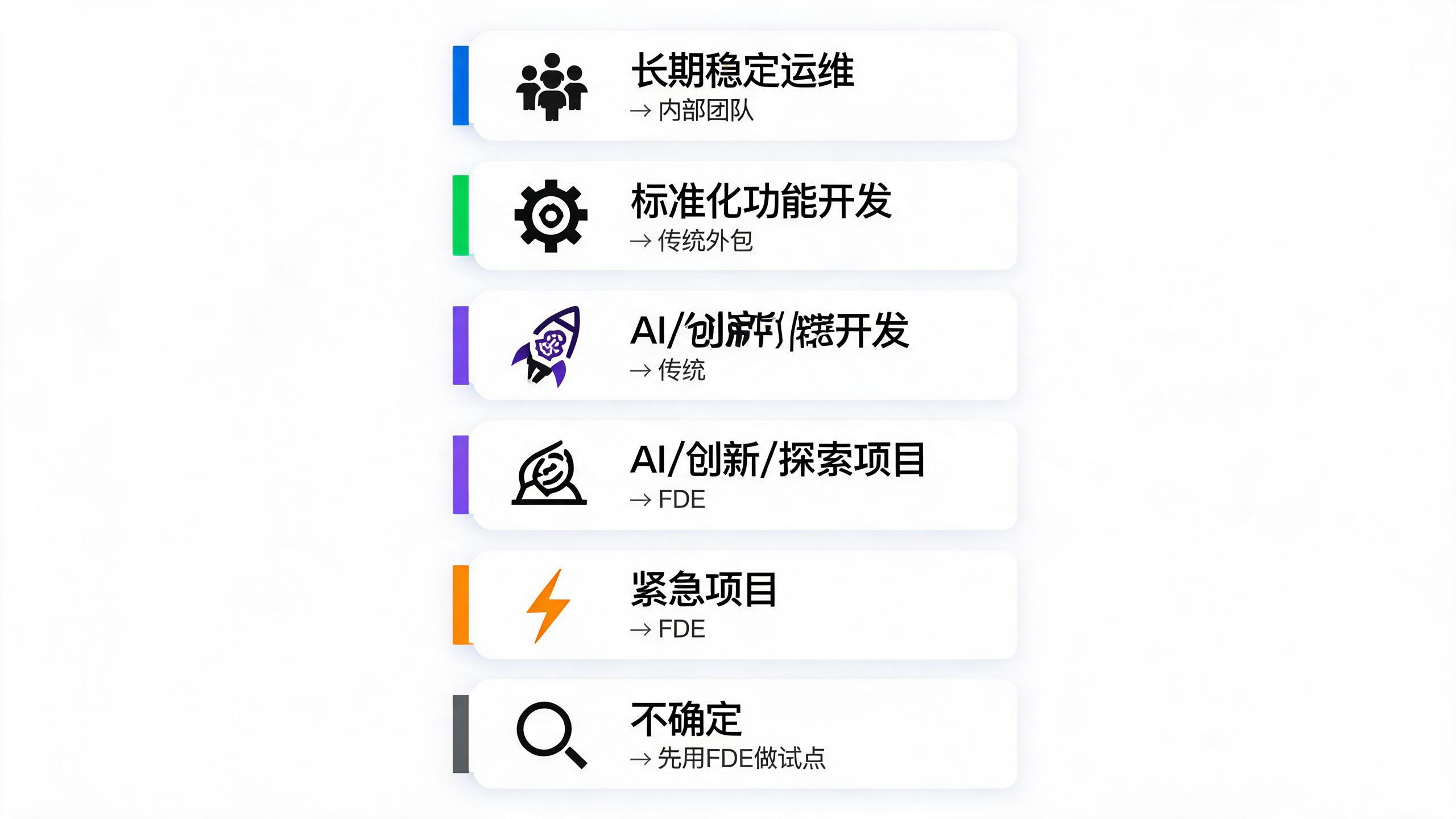
Figure: Optimal delivery models for different project types
Hybrid Models: The Optimal Solution Is Often a Combination
In reality, many enterprises don’t choose just one model—they mix and match:
Model 1: FDE + In-House Team
- FDE is responsible for: Upfront architecture design, core feature development, solving hard technical problems
- In-House Team is responsible for: Daily development, maintenance, feature iteration
- Applicable Scenario: Has a basic development team in-house, but lacks senior experts (such as AI experts, architects)
Model 2: FDE + Traditional Outsourcing
- FDE is responsible for: Requirement diagnosis, solution design, core module development, acceptance oversight
- Outsourcing is responsible for: Standardized feature development, testing, data entry, and other labor-intensive tasks
- Applicable Scenario: Large-scale project with both standardized and innovative parts
Model 3: In-House Team + Outsourcing + FDE Consultant
- In-House Team: Main development and maintenance force
- Outsourcing: Handles peak periods or non-core requirements
- FDE Consultant: Participates periodically, providing technical guidance, architecture review, and troubleshooting
- Applicable Scenario: Large enterprises with some technical foundation that need regular guidance from external experts
Core principle: Use FDE for the highest-value work, outsourcing for standardized work, and the in-house team for long-term work.
Selection Decision Tree
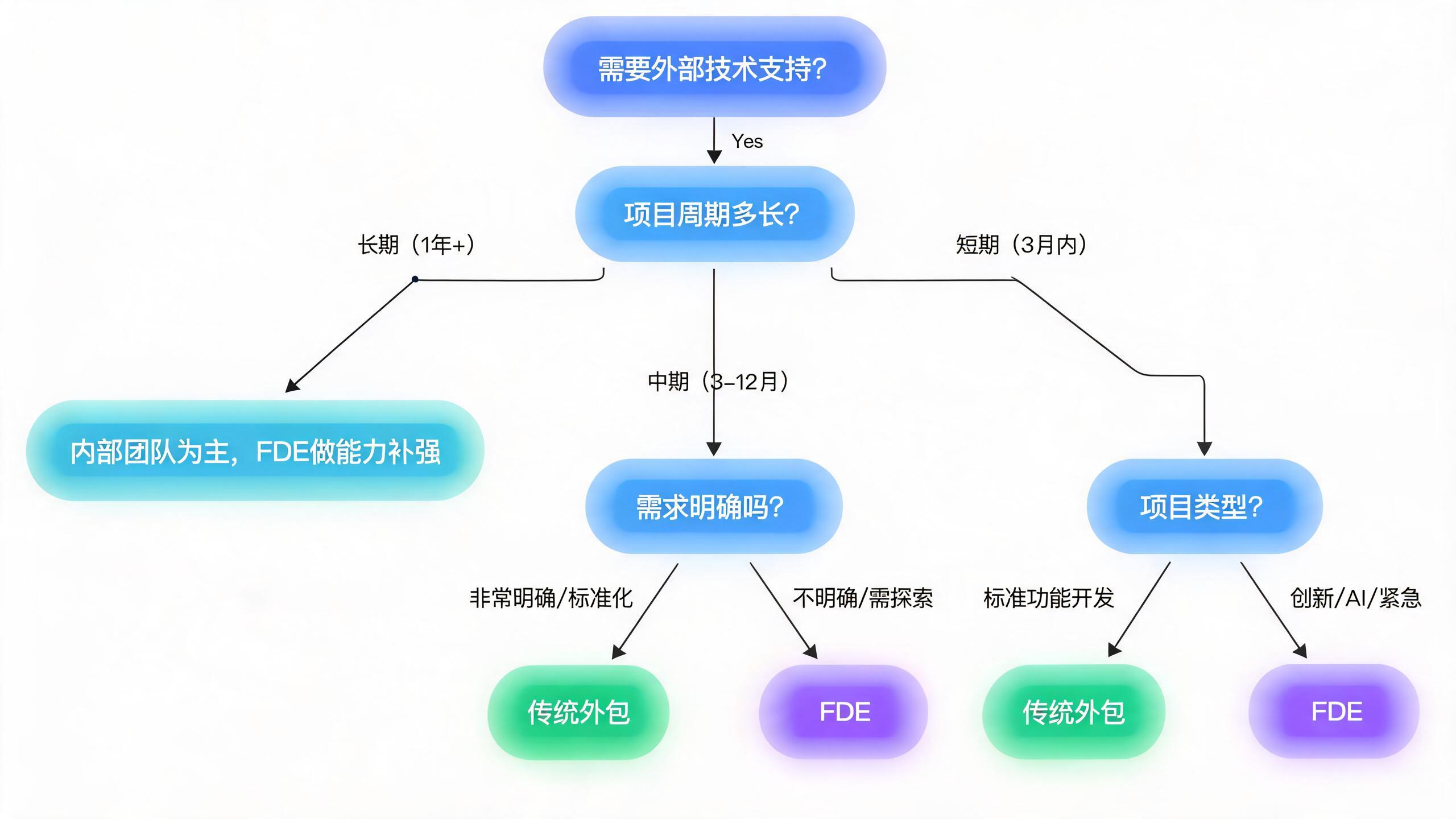
Figure: Delivery model decision tree by project cycle and requirement clarity
Considerations When Choosing FDE Services
If you decide to try the FDE model, the following points can help you avoid pitfalls:
1. Look at the FDE’s Actual Experience, Not the Company’s Brand
The quality of an FDE depends on that person, not the company. A large company may send a junior engineer; a small team may have a very senior expert. Be sure to talk to the actual FDE who will work on the project to assess their level.
2. Define Success Criteria Clearly and Sign an Outcome-Oriented Contract
Don’t just sign off on “what features to build”—also sign off on “what outcomes to achieve.” For example, “lead conversion rate increased by 15%” or “customer service response time reduced by 50%.” An outcome-oriented contract ensures the FDE’s interests are aligned with yours.
3. Start with a Small Pilot Project
Don’t sign up for a big project right away. Start with a small scenario (such as a one-month AI lead scoring pilot) to see how the FDE performs in capability, communication, and outcomes. Expand if it works well; cut losses if it doesn’t.
4. Assign an Internal Point Person and Participate Throughout
An FDE isn’t there to do it for you—they’re there to do it with you. Be sure to assign internal business owners and technical owners to participate throughout. This not only produces better outcomes but also ensures knowledge is transferred by project end.
5. Prioritize Knowledge Transfer to Avoid Creating a New Dependency
Knowledge transfer should happen in parallel during the project—coding standards, architecture docs, operations manuals, monitoring and alerting—to ensure the in-house team can take over after the FDE leaves. Otherwise, it becomes “outsourcing dependency in another form.”
Closing Thoughts
None of the three models is absolutely superior—only more or less suitable.
- If you want long-term capability and can bear the hiring and time costs—choose an in-house team
- If you want the lowest cost and the requirements are very clear—choose traditional outsourcing
- If you want outcomes and speed and the project is exploratory—choose FDE
In the AI era, more and more projects are exploratory—nobody knows what the optimal solution is, so you need to build, test, and adjust as you go. With this kind of project, the traditional outsourcing model has a high chance of failing, while an in-house team is too slow and too expensive. The FDE model is gaining popularity because, at its core, it matches the characteristics of AI-era projects.
Not every project is suited to FDE, but more and more projects will find that FDE is the optimal solution.
📚 FDE Series Articles
| Article | Core Content |
|---|---|
| Complete Guide to FDE (Forward Deployed Engineer) | Full analysis of role definition, value, capability model, and pricing model |
| FDE vs Traditional Outsourcing vs In-House Team (this article) | All-round comparison of the three models to help you choose the right delivery approach |
| FDE Project Delivery Process: End-to-End Analysis from Requirement Diagnosis to Knowledge Transfer | Breakdown of the standard delivery process—what to do and what to deliver at each stage |
| Why Do AI Projects Need FDE? Avoiding the 70% Implementation Failure Rate | Core pain points of AI implementation and how FDE solves them |
❓ Frequently Asked Questions (FAQ)
Q1: FDE is quite a bit more expensive than outsourcing—why choose FDE?
Because FDE’s “delivery quality” and “implementation outcomes” far exceed outsourcing. Many enterprises that have done outsourcing projects can relate: on the surface outsourcing is cheap, but in the end the system never gets used, and the money is effectively wasted. Although FDE has a higher unit price, it is accountable for results—the system actually works, the business actually improves, and the team actually learns. When you calculate the total, FDE’s ROI is often higher.
Q2: What’s the difference between an FDE and a technical consultant?
A technical consultant is someone who “gives advice”—provides suggestions, designs solutions, writes reports, but isn’t responsible for implementation. An FDE is someone who “rolls up their sleeves and builds”—not just providing a solution, but personally writing code, doing integration, pushing to production, and ensuring outcomes. In short: a consultant “tells you how,” while an FDE “shows you how and builds it with you.”
Q3: Won’t an FDE learn all the core technology and take it away?
This concern is actually backwards—an FDE is there to “empower you,” not to “steal your technology.” The core value of an FDE is bringing in advanced external experience, methodologies, and technical capabilities to help the client’s team grow. Moreover, FDEs serve many clients, and each company’s business is unique—what an FDE takes away is only general-purpose methodology, not your core business secrets. What you should really worry about is “learning nothing,” not “having something learned away.”
Q4: How do you judge whether an FDE is reliable?
Several criteria: first, technical depth—can they discuss technical details in depth, or do they only talk in concepts? Second, business understanding—can they quickly grasp your business pain points, or do they only pitch their own solution? Third, communication ability—does the conversation flow smoothly, can they get to the point? Fourth, past cases—have they done similar projects, and how did they turn out? The best approach is to start with a 2-4 week small pilot—proving it through actual action speaks louder than anything.
Q5: How long should an FDE engagement typically be signed for?
It depends on the project size. The smallest validation project takes only 2-4 weeks; a single-scenario implementation typically takes 6-8 weeks; a mid-sized system modernization takes 3-6 months; a large transformation project may take 6-12 months or longer. It’s recommended to start small—do a 4-6 week pilot first, validate the outcome, then renew. This minimizes risk and is also the easiest way to convince management.
If you’re struggling to choose a delivery model for your project, feel free to reach out to discuss. I can help you do a free selection assessment based on your specific situation.